Archive by Author

Housing Justice

30 Apr

The cost of housing faces almost everyone, especially those in growing urban cores. It even affects employers, nonprofits and churches who often cannot pay salaries high enough to cover rising housing expenses. This course provides hope and practical ways this crisis can and is being address as a mission of the church.

Radical Discipleship

DSC00001From Jill Shook, who is teaching an innovative course this summer on housing–through the lens of biblical Jubilee:

Ever since the Great Recession, low income people in record numbers have been deprived of their assets and displaced from their homes—from land meant to be used in a way so that all can have access to decent shelter. This is a form of systemic violence that violates the principles of Jubilee justice found throughout the Bible, from Leviticus to the Book of Acts. As Christians, we are called to take action to assist not only the refugees from war and violence but also those displaced in gentrified cities, where rents are soaring.

View original post 187 more words

Image

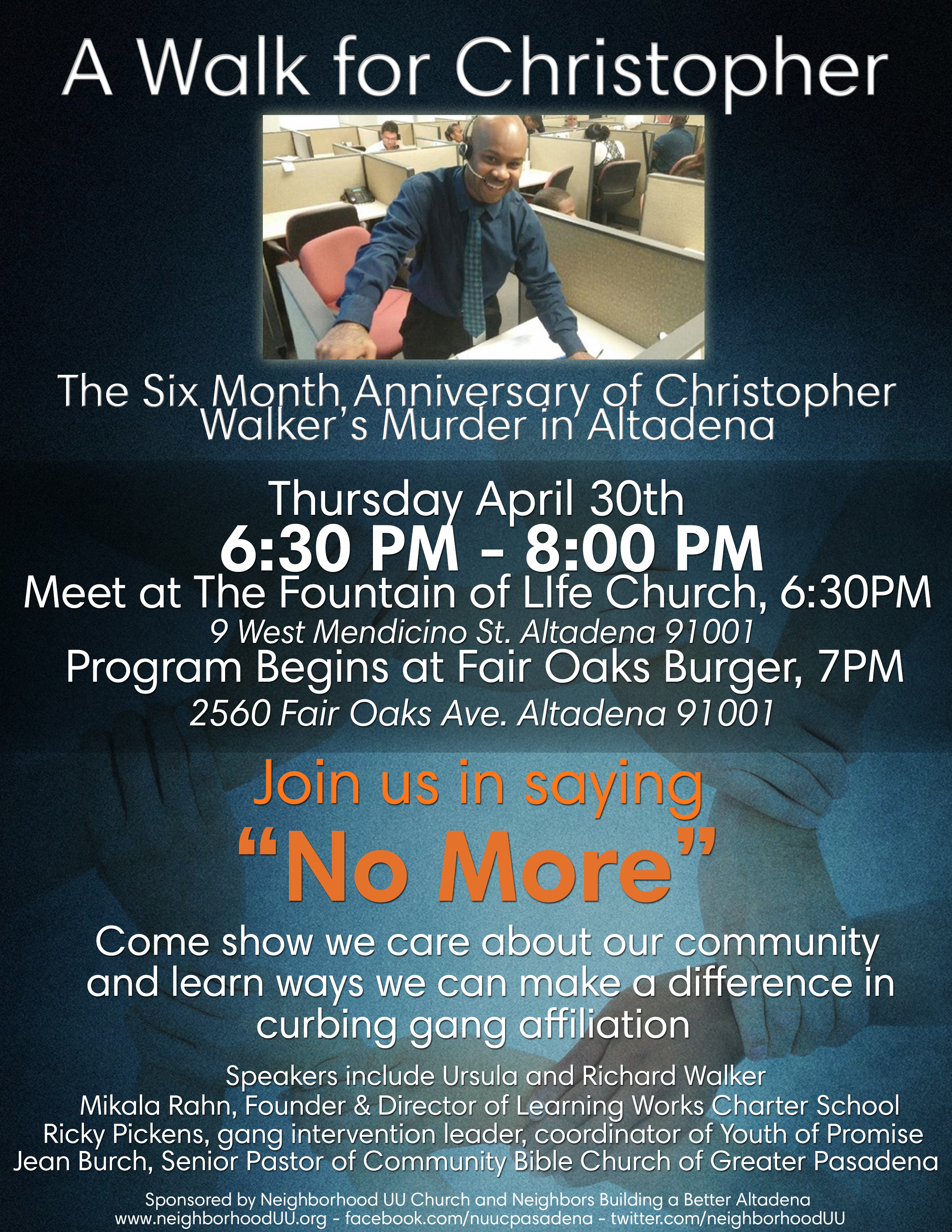
A walk for walker tonight–results of long standing housing segregation

30 Apr

AWalkforChristopherFlier

Launch of N. Fair Oaks Empowerment Project a Big Success!

14 Apr

In order to make any housing development successful, community organizing is an essential piece. It is important that the neighborhood way in and have a say in the kind of housing and the cost that would be appropriate for their community. It could be that housing isn’t what the community wants, so a developer needs to really hear from the community but often this essential step is skipped. For the past 20 years, my heart has been drawn to a neglected part of Pasadena on North Fair oaks, between Washington and Woodbury.  Not only is this area for the most part abandoned, but the 18 businesses and 8 churches also feel abandon. There is no meaningful relationship among them and no real collective voice. But God has raised up a team, and I am thrilled to be part of the process to help this community find its voice. We had our launch last Saturday Morning. My husband wrote a beautiful blog describing how God was present with us at this brunch and is behind this effort.

Follow this link to learn more about this project: Launch of N. Fair Oaks Empowerment Project a Big Success!

Housing Justice Course at Denver Seminary, June 22-July 2, 2015

12 Feb

You are invited to take part in a ground-breaking course dealing with America’s growing housing crisis. Learn how this crisis is being addressed by experts in the field.  What role do churches play in helping to create affordable housing and changing policies so that there is sufficient affordable housing for all–from the homeless and very low-income to those who cannot afford to live in the communities where they work. Dr. Jill Shook, nationally known as an advocate for housing justice, has helped to create hundreds of affordable units in her city and has written a book on affordable housing used as a text in college course and also by advocates across the nation. She has taught doctoral courses at Azusa Pacific, Bakke Graduate School and given workshops for the past 15 years at the Christian Community Development Association and elsewhere. Her work has been translated into Spanish and is being shared with pastors not only in the United States but also in Latin America.

This course will not simply be academic. It will take students into areas of Denver where Christian housing developers and visionaries are transforming their community through housing. Come and see how God is at work in this beautiful city!

Denver Seminary offers a unique Master of Arts degree in Justice and Mission, with courses on social issues like immigration, health justice—and now, housing justice. Housing Justice is a new course that will be offered June 22-July 2, 2015.  Dr. Jill Shook will be teaching this two-week intensive.

This course is open to anyone, not just Denver Seminary students. Note the registration dates however, the registrar needs a count on the number of students by May 10. International students will need to be register by March 15. So if you or someone you know is interested, please enroll soon.

Course Description

Housing Justice: Theological and Practical Foundations (JM 645): Develops a theological and practical understanding of how housing justice is part of God’s mission. It provides a comprehensive look at ways to house communities in light of biblical land use laws and the just and fair distribution of land and housing. Case studies are examined, which includes how churches and Gospel-driven visionaries are addressing the housing crisis, creating affordable housing, and transforming people and communities. Interactive assignments and site visits provide first-hand experience to engage with affordable housing developers and best practice models. Two hours.

To further pique your interest, here’s the reading list for the class – some really powerful and inspiring works!

Required Reading
  • A Decent Home: Planning, Building, and Preserving Affordable Housing, Allan Mallach
  • Making Housing Happen: Faith-based Affordable Housing Models, 2nd Edition, Jill Suzanne Shook
  • Streets of Hope: The Fall and Rise of an Urban Neighborhood, Holly Sklar
  • The Biblical Vision of Sabbath Economics, Ched Myers (available on Ched’s website)
  • The Land: Place as Gift, Promise, and Challenge in Biblical Faith, 2nd Edition, Walter Brueggemann
Suggested Reading
  • A Theology As Big As the City, Ray Bakke
  • A Theology of the Built Environment: Justice, Empowerment, Redemption, Timothy J. Gorringe
  • City of God, City of Satan: A Biblical Theology of the Urban Church, Robert C. Linthicum
  • Real Hope in Chicago: The Incredible Story of How the Gospel Is Transforming a Chicago Neighborhood, Wayne Gordon
  • Roots for Radicals: Organizing for Power, Action, and Justice, by Ed Chambers
  • Sidewalks in the Kingdom: New Urbanism and the Christian Faith, Eric O. Jacobsen
  • The Theology of the Hammer, Millard Fuller
  • Theirs Is the Kingdom: Celebrating the Gospel in Urban America, Robert Lupton

A link to the course and all books are available through the Denver Seminary bookstore website under Summer 2015.

Course Registration

All applicants must apply for admission through Denver Seminary. To begin the application process, please visit this site: http://www.denverseminary.edu/admissions/admission-application/. There are several ways to register:

1) If you’d like to take the course for earned credit, you’ll need to apply for admission. You can apply as a non-degree student, which is a much quicker process than for degree applicants. For more information, contact: admissions@denverseminary.edu. The cost is $540 per credit hour and please register as soon as possible.

2) For auditing, there are two options

a. Audit with record: You’ll receive a transcript of your course audit. This requires a brief application process – contact admissions@denverseminary.edu. The cost is $175 per credit hour.

b. Audit without record: No transcript will be provided. This option is just $35 but applicants need to meet one of the following criteria:

    • Denver Seminary graduate
    • Mentor of a current student or of the student’s spouse
    • Spouse of a currently enrolled student
    • Full-time employees of Denver Seminary and their spouses/children
    • Denver Seminary board members
    • Individuals ages 65+ years
    • Full-time Christian employees of non-profit Christian organizations

To audit without record, contact the registrar’s office (registrar@denverseminary.edu) and apply at least a month before the course begins. Seating is limited to 10% of the class enrollment and is first come, first served, so apply early.

3) Visiting Student Applicant (The cost is $540 per hour)

Students from other accredited graduate schools are welcome to study on a limited basis. A visiting student may not become a degree-seeking student unless they complete the requirements outlined for a transfer student. Application procedures for a visiting student are as follows:

1. Submit a completed application along with a $35 application processing fee.

2.Submit a letter from the chief academic officer indicating that the applicant is a student in good standing and authorizing the courses in which the applicant will enroll.

3. Official transcripts from current school, if requested.

Please feel free to share this information with anyone who might be interested, especially those in the Denver area. If you have any questions, don’t hesitate to contact me at jill@makinghousinghappen.com. I hope to see you in June!

Unlikely Connections: Korean’s Learn from Japanese about Affordable Housing

28 Oct

With Christian missions we can bring a gospel of peace simply by building meaningful relationships with ethnic churches and local community development organizations.

I had the honor of giving four presentations on affordable housing to ReconciliAsian, a network of Korean pastors in LA dedicated to peacemaking in the Korean community. Speaking with these Korean pastors was a Christ centered experience. The group was so fully engaged I could feel the presence of Christ at work as I was speaking.

When Sue Park, co-director of ReconciliAsian, asked what I would like to speak on during their recent Justice & Peacemaking School on October 7th & 8th. Having spoken to them twice before on a theology of land and housing and various models of how churches across the nation have built affordable housing, I wondered if the Korean pastors were ready to actually consider building affordable housing on their church properties (for example on their large parking lots). If so, then the next step would be to experience and see affordable housing firsthand. I suggested that Sue contact the Little Tokyo Service Center, a Japanese community development organization. Considering the painful history between Japanese and Koreans this tour and learning experience was itself a step towards reconciliation.

Even though the Little Tokyo Service Center made it clear that they were not religiously affiliated, it was clear to all of us at the end of the tour they were doing God’s work. We toured their first affordable housing property built 35 years ago with 100 units. Originally the city was planning on purchasing this property for expansion of municipal facilities and had given eviction notices to all the residents. Because the Service Center had relationships with the tenants they worked with them to become advocates and the city decided not to expand, giving the Service Center the building. This building was a stunning monument to God’s beauty in how it was redeveloped. Since then, they have developed 25 properties. When the Service Center develops in Little Tokyo they already know their community, but to be sustainable elsewhere, like Korea town or Filipino town, they build local teams and equip them in the development process, even dividing their development fee with them. Among developers this is highly unusual and demonstrates aspects of how Jesus empowered others and how the early church shared property.

I began this blog with the idea that we “bring” the gospel to the community. In reality, God is already at work redeeming and restoring all things. I feel so grateful to be able to participate in this process with amazing groups like the Little Tokyo Service Center and ReconciliAsian.

Learn more about ReconciliAsian or the Little Tokyo Service Center.

A Churches Role in Preventing & Ending Homelessness

14 Oct

I really love the work Lake Avenue Church is doing to prevent and end homelessness in Pasadena. The idea of ending homelessness is powerful and possible. All too often our Churches are involved in simply managing homelessness by limiting their capabilities to feeding and clothing ministries, not realizing God can multiply our efforts if we learn and partner with an aim to actually end homelessness. We need to take that next step of building relationships with those homeless sleeping at our Church doorsteps. We need to build relationships with our local city and county programs that are working with the Housing First model, a model proven with clear nationwide evidence based research.

By holding hands with our homeless friends and Housing Frist programs, we can realize what the early Church did in Acts 4 when they ended poverty. Let us do the same. Mark out a manageable geographic of a few blocks around our Churches or a part of town where the most vulnerable stay and decide to end poverty in that area. We can’t do it alone. We need partnerships. We need other Churches, city staff and officials. Once we have done our homework, we may be in a position to educate our city staff and support them in what must be done. We need to help our planning departments initiate a homeless count so they become aware of local needs. With hard data our local cities can apply for the necessary resources.

Some Churches are seeking to prevent homelessness before it ever transpires, an even more affordable and sustainable approach. Lake Avenue Church in Pasadena has begun a program that helps prevent homelessness by helping those facing evictions. I thank God for Lake Avenue Church and the Lake Avenue Community Foundation, which is taking seriously the example of the early Church by focusing intensely on a manageable geographic and seeking to break the cycles of poverty through their outreach programs.

Lake Avenue Church: Crisis, Advocacy, and Prevention

“LAC provides crisis intervention and preventative assistance and support for those who are at-risk of eviction or are currently homeless. Our task is to “bridge the gap” for persons who are in a short-term crisis. LAC also works closely with the comprehensive range of resources available in the local community by providing prayer, guidance, mentoring, accountability, and advocacy.”

Aljazeera Features how to be Downwardly Mobile for Jesus

14 Oct

I just returned from this year’s Christian Community Development Conference where over 3,000 attended. This year we met in Raleigh, NC. I feel so honored to be part of a national network of followers of Christ committed to Reconciliation, Redistribution and Relocation–the three “R”s that are the core of CCDA. This article that appeared on the front page of Aljazeera explains well some of the long term ramifications of developing under-resourced communities. Investing in a low income community can attract higher income neighbors pushing up the housing costs. This year I helped coordinate a Housing Symposium and an Action Tank–which looked at policies to help prevent housing displacement. I’d love to hear your thoughts on this amazing article.

Mathew Loftus holds a meeting of New Song Community Church's mental health group in his house after Sunday service.

Meet Matthew Loftus. “He doesn’t fit into the typical narratives about changing American communities. On one hand, recent housing policy has encouraged integrated suburbs by helping low-income families access communities of opportunity with more jobs, less crime and better schools. When integration moves the other way — into poor urban neighborhoods — it often tips over into gentrification as upscale amenities arrive, taxes and rents rise and longtime residents get priced out.”

Read the rest of Downwardly mobile for Jesus

Photo credit: Brooks Kraft for Al Jazeera America

Churches Can Initiate the First Step to Ending Homelessness by Counting

14 Oct

Pasadena is a model in many ways, with a host of volunteers conducting yearly homeless counts which provides hard data that has allowed the city and other non-profits to apply for funding and housing vouchers.

If a city has homeless and they haven’t yet conducted a count, this is the first step to ending homelessness. The Census Bureau itself does not require homeless counts and cities can often deny that they have homeless residents; this is where the Church can play a pivotal role. The book of Chronicles as well as other chapters throughout the Bible provide detailed lists of people by name recorded for all eternity. Churches can make visible the often invisible by initiating and participating in a count. Churches can contact Urban Initiatives to learn how homeless counts should be conducted and can play a significant role in the first step to ending homelessness.

Contact The Office of Urban Initiatives at Fuller Seminary

The city of Pasadena has done an excellent job of providing a significant level of services and housing for the homeless community thanks to Bill Huang, Director of Housing & Career Services, and Joe Colletti, Executive Director, of Urban Initiatives. The article below by Lauren Gold describes Pasadena’s 2014 homeless count and the significant role of Fuller Seminary.

“Homeless Count Helps Provide Data for Services” by Lauren Gold, reporter at Pasadena Star-News

Photo Credit: James Carbone for the Pasadena Star News

Housing Justice: Theological and Practical Foundations

20 Sep

I am really excited about this new course I will be teaching at Denver Seminary next summer. Please consider taking the course and/or pass on this information to others who might be interested.


Housing Justice: Theological and Practical Foundations

A two-week intensive course for Denver Seminary, June 22-July 2, 8:30-12, 2015

Professor:  Dr. Jill Suzanne Shook, MA. Denver Seminary, D-Min Bakke Graduate School, author and editor of Making Housing Happen: Faith Based Affordable Housing Models (Cascade: Eugene, OR, 2012).  Jill@makinghousinghappen.com  (626) 675-1316  website: www.makinghousinghappen.com

Course Description:  This course offers a theological and practical understanding of how housing justice is part of God’s mission. It provides a comprehensive look at ways to house our communities in light of biblical land use laws, and the just and fair distribution of land and housing.  We will examine case studies of how churches and Gospel-driven visionaries are addressing the housing crisis, creating affordable housing, and thereby transforming people and communities. Interactive assignments and site visits will provide students with first-hand experiences to engage with affordable housing developers and best practice models.

This course highlights four major aspects of evangelical understanding of housing justice:

  • Theology of land and housing: The just distribution and accessibility of land and housing is not only very good news for the poor, it is a key aspect of the biblical vision of shalom.  We will examine this theology as well as the praxis of housing justice through various biblical, historical and cultural perspectives (i.e. Jubilee economics, prosperity—wealth creation, etc.). We will also critique the past 100 years of US housing experimentation and the role of the church in shaping housing policy.
  • Evangelism and redemption: When people of faith create access to housing for the most vulnerable, it can become a visible expression of love and justice, and an opportunity for the prophetic proclamation of the Gospel.  This course will foster a deeper understanding of the Gospel by considering practically how the “last will be first” in creating housing justice, as we explore how the stories of those with pain of homelessness and housing hardships can become a tool for redemption and restoration of both people and places when told to those who have the power to affect change.
  • Housing Justice: What is housing justice and why is it necessary? This course will consider the emotional and socio-economic need and scope of the housing crisis and debate issues related to the crisis: displacement, segregation, gentrification and more. What is the purpose of a home? Is housing a right? What is affordable housing? What role should the church and government play in helping to create affordable housing? Theological, historical, and cultural frameworks of rental and homeownership models will be explored: individual and shared; full, limited and no equity—including models of community land trust, co-housing, cooperative housing, and more.
  • Community Transformation: A comprehensive approach to housing justice results in community transformation. Housing justice requires thoughtful community engagement, discerning wise partnerships, and the courage to hear and follow God.  These concepts will be explored through the lens of Joseph, Esther, Ezra, Nehemiah, Jeremiah and Jesus.  Definitions of various models of community transformation will be clarified, including the following: partnerships, social services, equipping (non-formal education, including conferences and certifications), community development, advocacy, community organizing and social movements.

DENVER SEMINARY STUDENT LEARNING OUTCOMES

Denver Seminary is committed to students attaining four learning outcomes. This course most directly contributes toward the realization of the following learning outcomes:

  1. Integrated biblical and theological competence.

This course will foster a comprehensive as well as analytical mastery of the theological and biblical content that informs the missional praxis of housing justice.  It will contribute toward discernment of vocational calling, especially as affordable housing practitioners are engaged during field trips. This content will be integrated through class lectures, student presentations, viewing of two documentaries, in-class debates, the use of on-line interactive tools, the telling of personal housing stories, a field trip and discussions with personal reflection sensitive to their own theological and community context.

The student’s progress toward this mastery will be assessed by the professor’s evaluation of active participation in class discussion, individual and group presentations, five pop quizzes including in-class writing assignments on the analysis of readings, four one-page book reviews and two final theological and integrative papers.

  1. Course Goals:

At the end of this course students will:

  1. Understand land use, affordable housing practices and housing policy from biblical and theological perspectives, and be able to discuss complexities of housing justice.
  2. Articulate their own housing story with cultural sensitivity and clarity, their own theology and convictions regarding homes, land and housing and know how to help others do the same.
  3. Develop critical thinking skills in evaluating and recognizing just and fair housing models and policies, and discern what models might be economically, culturally and historically appropriate in their own community.
  4. Learn methods of housing justice praxis; the role of prayer, discernment, relational work, and if need be, partnerships; accessing of resources, including need and asset assessment tools, certifications, leadership and fund development and more.


REQUIRED TEXTS


Required reading will total 1,200 pages, which is standard for 2-hour Denver Seminary courses.


Primary textbooks:


Brueggemann, Walter. The Land: Place as Gift, Promise, and Challenge in Biblical Faith. Fortress Press: Minneapolis, MN, 2002. (150 pp)

Mallach, Alan. A Decent Home: Planning, Building and Preserving Affordable Housing, 2009 (364pp)

Medoff, Peter, and Sklar, Holly. Streets of Hope: The Fall and Rise of an Urban Neighborhood (289 pp)

Myers, Ched. Sabbath Economics (60 pp)

Shook, Jill Suzanne, editor. Making Housing Happen: Faith-Based Affordable Housing Models (MHH). Cascade Books: Eugene, OR, 2012. (269 pp)


Students desiring more intellectual rigor may replace Streets of Hope: The Fall and Rise of an Urban Neighborhood with Gorringe, T.J. A Theology of the Built Environment: Justice, Empowerment, Redemption. Cambridge University Press: Cambridge, MA, 2002. (261 pp)

The following books will be available on reserve either at the library, on-line, so purchasing them is optional. We will be reading only selected excerpts from the list below (see class schedule)


Popple and Leighninger. Social Work, Social Welfare and American Society, 8th edition, Chapter 14: “Housing, Homelessness and Community Development” (a written request will for the rental or purchase of this 47 page chapter must be sent to: Allyn and Bacon, Permissions Dept, 75 Arlington St, Boston, MA 02116, or faxed to 617-848-7320)


On-line articles:

“Gentrification with Justice” by Bob Lupton: http://sites.silaspartners.com/partner/Article_Display_Page/0,,PTID323422_CHID664014_CIID2235910,00.html

Search several articles from the ShelterForce and Rooflines archives website (http://www.shelterforce.org/)

Dreier, Peter. “The phony case against rent control.” (31 pages) (http://scholar.oxy.edu/cgi/viewcontent.cgi?article=1364&context=uep_faculty)


Recommended optional reading of one of the following will provide extra course credit:


Bakke, Ray. A Theology Big as the City. Intervarsity Press: 1997. (207 pp)

Chambers, Edward. Roots for Radicals. Continuum: 2003. (142 pp)

Fuller, Millard. The Theology of the Hammer. Smyth and Helwys Publishing: Macon, Georgia, 1994. (151 pp)

Gordon, Wayne. Real Hope in Chicago: The Incredible Story of How the Gospel is Transforming a Chicago Neighborhood. (205 pp)

Jacobson, Eric. Sidewalks in the Kingdom: New Urbanism and the Christian Faith. Part 1. Brazos Press: Grand Rapids, MI, 2006. (69 pp)

Lupton, Robert D. Theirs is the Kingdom: Celebrating the Gospel in Urban America. Harper and Row: San Francisco, CA, 1989.  (121 pp.)


SUMMARY OF ASSIGNMENTS AND REQUIREMENTS


  1. Timely, faithful attendance and active, appropriate participation in discussion (includes one group presentation) –15% of final course grade
  2. Five quizzes/in-class writing assignments based on readings—20%
  3. Four one-page reviews of books (1,200 words total)—15%
  4. Final integrative theological position paper (2,200 words)—25%
  5. Final integrative praxis position paper (2,200 words)—25%


Total writing requirement=18 pages (@ 300 words/page.) Denver Seminary requires 15-18 pages for a 2-hour class.


The standard Denver Seminary 100-point grading scale will be applied to each assignment and the cumulative course grade:

87-89 = B+ 77-79 = C+ 67-69 = D+
93-100 = A 83-86 = B 73-76 = C 63-66 = D 59 or below = F
90-92 = A- 80-82 = B- 70-72 = C- 60-62 = D-


DESCRIPTION OF AND GUIDELINES FOR ASSIGNMENTS


Note: For written work in this class, I would prefer double-spaced papers using 11-point Times Roman front and one-inch margins, which usually means 350 words per page. Assignments can also be emailed as an attachment to jill@makinghousinghappen.com. Paper length is judged by word count, not pages. Since no extra research is required, academic format is not emphasized. However, if you do refer to other works, please footnote properly using Turabian style. Of course, plagiarism is not permitted and will be prosecuted to the full extent of the law as outlined in “Policy on Academic Integrity” in the Seminary’s student handbook.


  • Timely, faithful attendance and active, appropriate participation in discussion (includes leading two group presentations on a chosen book)


  • Attendance is vital: without it, neither learning nor contributing to others’ learning can happen. Unexcused absences result in a zero participation grade for that class session.
  • Participation should be active but balanced. For those who have a lot to say (like myself) that may mean stepping back to invite others into the conversation. For those less eager to share their thoughts in groups, that may mean well-planned, intentional resolve to speak out.
  • Each of our four units will conclude with group presentations applying the theological concepts covered by the unit to one of the four contexts of injustice discussed in week two:


Students will sign up to participate in one group presentation for the entire course; detailed instructions will be made available at that time.


  1. Five quizzes/in-class writing assignments
  • Quizzes will NOT be announced in advance. They will take place randomly at the beginning of class and will cover the reading material due that day. Critical engagement with course readings is vital for everyone in our learning community—so quizzes are just one more way of providing incentive for reading well.


  • Integrative theological position paper (2200 words)


  • This paper should integrate key learnings from the material presented in the course into a coherent expression of the students’ theological stance concerning housing justice and mission. Students should use their class notes and reading analyses to distill into one document their overall “takeaways” for the course. The paper should include:
    • a summary of the main debates covered in the course.
    • an articulation and defense of the students’ positions vis a vis these debates.
    • an integration of the students’ stances into a clearly articulated holistic mission theology of housing justice.


  • Integrative missional praxis paper (2200 words)


  • This paper should reflect on the practical implications of their theological convictions (expressed in the previous paper) for their own missional praxis. The paper should highlight:
  • which concepts, debates, or convictions hold the most practical relevance for the student.
  • How the students’ theological convictions would influence missional praxis in the context


COURSE SCHEDULE


DATE CLASS SESSION READING DUE ASSGTSDUE
Session 13 hours Introductions, overview of syllabus, theological frameworks and housing stories 

Devotion reflection: Moses Duet. 15, and Is. 58: 6-12

The Land, Brueggemann; Making Housing Happen (MHH), Shook Ch. 2; Sabbath Economics, Myers One-page book reviews on Brueggemann and Myers due 
Session 2(3 hours)


Defining the housing problem and context: the history of housing and housing policy in the US and role of the church 

Debate: is housing a right or commodity?


Devotion reflection: Ruth and Naomi, Prov. 29:7; Is. 65:17-22

A Decent Home, Mallach, Ch. 1, 2, and 11; MHH, Ch. 1; Streets of Hope, Medoff, and Skylar Ch. 1  Define the housing problem in your community by use of Census data. 

Determine housing wage for your community; http://nlihc.org/library/wagecalc

Session 3(3 hours) Consequences of housing policy: what we can learn from other nations, review of integration paper. View: documentary Inside Job, depicting the early 21st Century financial crisis and global economic meltdown of 2008. Discuss the mortgage crisis: banking practices, Glass-Steagall Act and PICO’s response 

Devotion and reflection: Esther, Ezek. 36:33-36, Matt. 6:9-13

Social Work, Social Welfare and American Society, Ch. 14 Policy group assignments and presentations on housing policies, beginnings of integrative paper
Session 4(3 hours) Ways to make housing happen: sweat equity, rehab, and adaptive reuse. 

Devotion reflection: Ezra, Ex. 22:25, Duet 23:20, Lev.25:35-37;

Mallach, Chapters. 7 and 9; Shook, Chapters 3, 4, 5 and 8 Shelterforce and on-line search for pros and cons of   housing models in lecture http://www.shelterforce.org/
Session 53 hours Housing preservation, barriers to housing. Documentary: Battle for Brooklyn, in which residents fight to save their homes. Discussion: displacement, segregation, gentrification and the prophetic role of the church. Debate: Community Benefits Agreements (CBAs) and imminent domain 

Devotion reflection: Jeremiah 29, Prov. 23:10, Micah 2

Mallach, Ch 10“Gentrification with Justice,” Lupton http://sites.silaspartners.com/partner/Article_Display_Page/0,,PTID323422_CHID664014_CIID2235910,00.html


Shelterforce and on-line search for pros and cons of   CBAs,http://www.shelterforce.org/


Review the “Myths and Facts about Affordable Housing” and “Higher Density Development”

Session 63 hours More ways to make housing happen: Tenants taking ownership, mixed use/mixed income, cooperative, cohousing, community land trust, models of neighborhood and church empowerment 

Devotion reflection: Acts 4: 31-36; Rom. 12; 1 Cor. 12 and Eph.

Mallach, Chapters 3, 4, 5 and 6Shook, Chapter 6, 7, 8, 11, 12 and 13 Peruse the Community Land Trust Network. research the CLT closest to your community. 

Visit Urban Homeworks site, watch Chad Schwitters’ doodileo

Sessions 7 and 8 

6 hours, including lunch

Field Trip to:

  1. Ray Stanske’s work, Transit Oriented Development (TODs)—throughout the Metro Denver area.
  2. Larry Fullerton, President of Hope Communities, The Point—at Denver’s Five Points (Mixed use and mixed income)
  3. Denver’s Housing Department
Mallach, Ch 12, and 13  One page reflection on what was learned from the field trip. 

Streets of Hope, or Theology of the Built Environment on- page review due


Session 93 hours Community organizing, advocacy,Nehemiah Housing Strategy, intermediaries (financial resources), Smart Growth


Devotion reflection: Nehemiah, Is. 65, Zach 8:4

Shook, Ch. 14, and 15 One-page review of Mallach’s A Decent Home due
Session 103 hours Environmentally wise building materials, policy trends and debate on rent controlDevotion reflection: Jesus, Gen 1 and Rev. 21 Shook, Ch 16, 17Dreier, “The phony case for rent control” One-page review of Shook’s, Making Housing Happen due


waiting lists for vouchers in almost every community

19 Sep

The Section 8 Voucher waiting list has been closed for 5 years in Pasadena, but will be opening for a 2 week window the last two weeks in October!

Association Against Homelessness in America

Indeed, as the report notes, there are currently “waiting lists for vouchers in almost every community,” and only 1 in 4 eligible households receives a voucher or some other form of federal rental assistance. Half of the current households in the voucher program include seniors or people with disabilities, and the rest are mostly families with children.

FULL STORY

View original post