Archive | Uncategorized RSS feed for this section


Please support MHCH and come to our annual celebration on Sun. Nov. 19!
26 OctJoin Us for Our Annual MHCH Celebration!
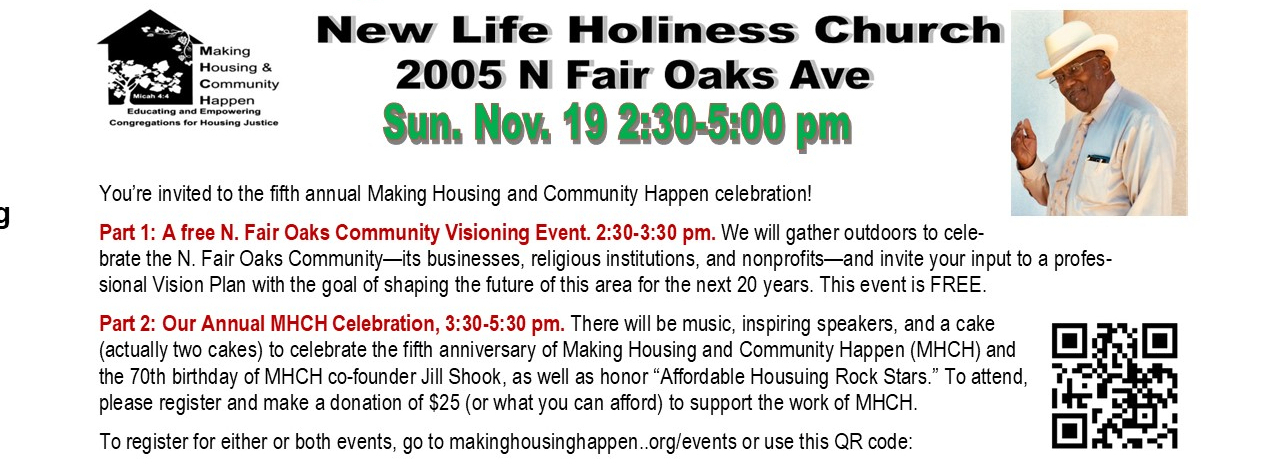 Register today for this two-part event: a community visioning event from 2:30-3:30 pm and our annual MHCH celebration from 3:30-5:00 pm. To register click here.
You’ll learn about our MHCH teams, local organizations, churches and businesses and more. There will be music, inspiring speakers, and a cake (actually two cakes) to celebrate the fifth anniversary of MHCH and the 70th birthday of Jill Shook, co-founder of MHCH. We will bestow Affordable Housing Rock Star Awards on those who’ve made a significant contribution to affordable housing. This celebration will take place at New Life Holiness Church, 2005 N Fair Oaks Ave, Pasadena, CA 91103.
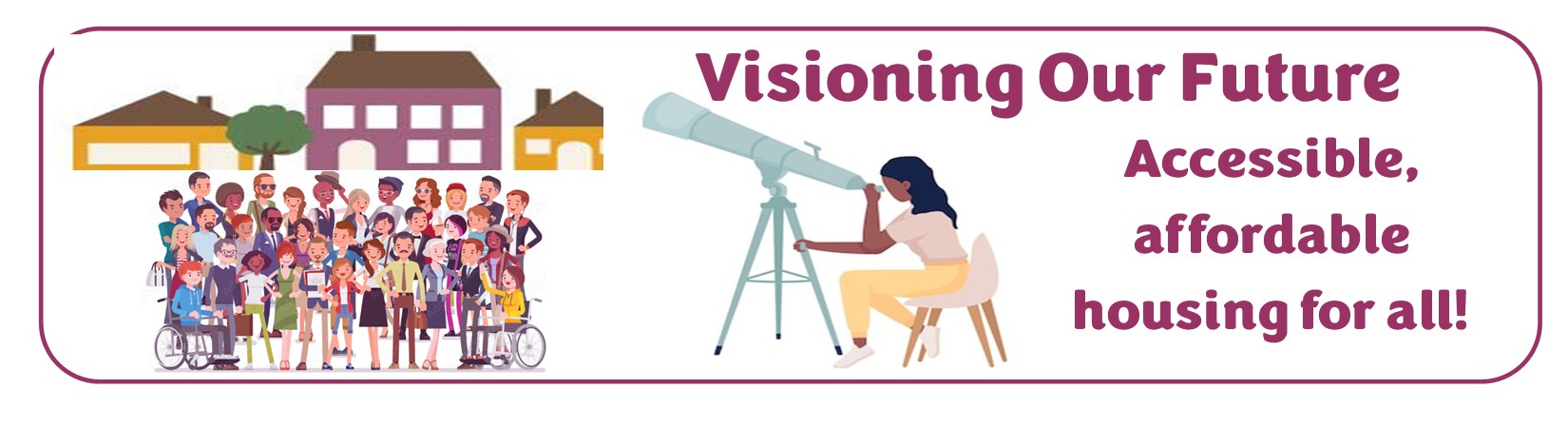
We so appreciate your support as we seek to fulfill our mission to ensure safe, accessible and affordable housing for all.
This past year has been one of remarkable successes, all pointing to an exciting future. That’s why we are calling our Fall/Winter Campaign: “Visioning Our Future: Accessible, Affordable Housing for All.” We need your support to help us reach our goal of $40,000 by the end of this year. To donate, please click here.
Our successes include:
Our Affordable Housing Bus Tour attracted over 70 participants, including 38 mayors and elected officials. We demonstrated not only that affordable housing is beautiful and benefits communities, we also helped decision makers see how to make it happen.
SB 4 passed, after a three-year advocacy campaign that we helped initiate. This bill makes 170,000 acres of religious land available for affordable housing statewide. This is a gamechanger for churches in California and for our Congregational Land Committee!
The Congregational Land Committee’s work continue to expand, with teams forming in N. California, Colorado, Texas and Washington, thanks to our Apprenticeship Program. Here in Californnia:
- 85congregations have shown interest
- 25completed prep classes (4-session cohorts)
- 22feasibility studies completed
- 3requests for proposals
- 3 agreements with affordable housing developers
Our N. Fair Oaks Empowerment Initiative is doing significant racial justice work and community organizing as MHCH member and urban planner Phil Burns helps us to develop a Vision Plan (worth $20,000) that will help revive this under-resourced area of our city for the next 20 years. Our annual event will take place on Nov. 19 in the heart of this once thriving African American community.
Our Safe Parking program has found housing for 5 parkers living in their vehicles, and we also helped pass an ordinance that makes safe parking a permitted use for congregations in non-residential zones.
The Bible tells us “without a vision the people perish” (Proverbs 29:18). Our vision comes from the prophet Micah: “Everyone ‘neath their vine and fig tree will live in peace and unafraid” (Micah 4:4) . God’s intention is for everyone to have accessible, affordable and secure housing. That’s the mission and the vision of MHCH. Please help us make this vision a reality with your support!
Share this:

Housing Justice Forum: Deep Dive into SB 4, Rezoning Religious Land for Affordable Housing
19 SepPlease join us for our next Housing Justice Forum on Tuesday, Oct 24, at 7:00 pm via Zoom. Experts will explain and analyze SB 4, an important new bill rezoning religious land statewide for affordable housing. For the past three years we advocated to get this bill passed and now it could be a gamechanger, allowing many more congregations to provide affordable housing. To register, click here.

Share this:

Let’s Create a New Vision for N. Fair Oaks Community: Sun. Sept. 17th event at La Pintoresca Park
12 Sep

Image
Join us! Long Beach Housing Justice Housing Institute Sat. Aug. 5, 2023
27 JulPlease join us in Long Beach Housing Justice Institute on August 5th. Please read the goals and activities of the day below. 
The goals of the day are to: 1) Encourage a group of faith leaders to emerge to advocate for housing justice. 2) Learn best practices to end homelessness, 3) Utilizing religious land for supportive and affordable housing. To help achieve these goals, the One-Day Institute will provide an overview of our own housing stories, God’s story, and by playing the Unjust Housing Policy Game, the story of affordable housing in the US for the past 100 years—factors that have caused today’s crisis and what we have learned that works. We will look at what congregations are doing to build affordable housing, the development process, best practices to end homelessness, a practical theology of land use, and advocacy from a Biblical perspective, an overview of polices that work and what it takes to mobilize people of faith to do housing justice.
Share this:

Loving your City and Neighbors as Yourself: A Theology of Land and Housing.
25 Jul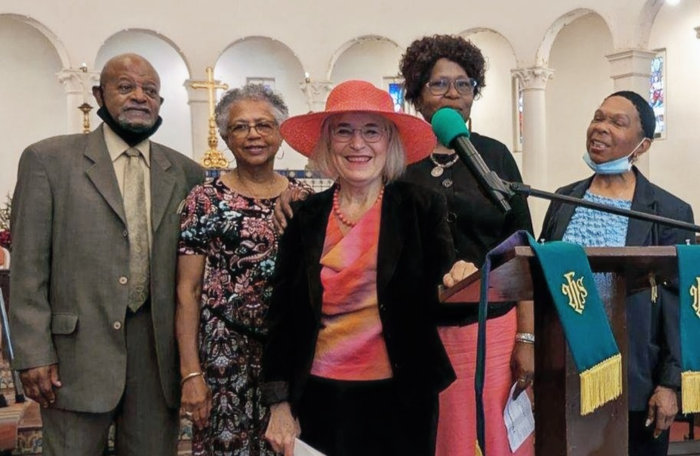
A message by Jill Shook at First United Methodist Church on July 23, 2023
A few months ago, I was here for a service and sat in that area of this sanctuary with a team of folks from around the US, CO, Texas, Oregon, Washington State and N. Cal to learn from you and your example of the topic I’m planning to share with you today.
My topic today is: Loving your City, and Neighbors as Yourself: A Theology of Land and Housing.
First let’s talk about how God loved cities. In the Bible, cities like Philadelphia are lifted up as examples of brotherly love. And others were lifted up as examples ripe for judgement-like Sodom and Gomorrah. The prophets of old spoke to cities and nations. They rarely spoke to individuals. I speak Spanish and in Spanish there is a word for “you” in the plural form “Ustedes” This is not the case in English. We just have “you,” and the context helps us to know if it singular of plural. We typically as an individualize society we read the Bible as everything in the Bible as applying to us individually, but God mostly was using the “Ustedes” form but in Hebrew, Aramaic and Greek.
This changes everything in how we read the Bible.
God loved cities enough to send the prophets or messenger to address cities and nations using the plural “you” telling them how they needed to change their ways—God’s mercy and love was so severe at times, they were warned of pending judgment if they don’t change their ways. God was committed to a relationship with cities, communication to cities, and with cities letting them know in advance the consequences of their ways. God even negotiated with Abraham about the pending judgement of Sodom.
We think of meeting God out in nature somewhere, but God is at work in cities, in fact over 280 cities are mentioned in the Bible, but not any city is mentioned more than Jerusalem. And because of their disobedience, most of its residents were exiled to Babylon.
While the prophets cried out for obedience to the law, they also envisioned a return to the land and a renewal of Israel’s faith in God. Even as the Babylonians were laying siege to Jerusalem, Jeremiah bought land in his hometown. Jeremiah’s purchase provided hope for urban renewal, by demonstrating with his example in Ch. 32:15, NLT that, “Someday people will again own property here in this land and will buy and sell houses and vineyards and fields.” Jeremiah spoke of a messiah who would come and “do what is just and right in the land” (33:15, NLT). Isaiah, too, looked forward to the time when Jerusalem would again be a place of peace and prosperity, when God’s people would again have a home. Isaiah 65 says, “They shall build houses and inhabit them; they shall plant vineyards and eat their fruit. They shall not build, and another inhabit.” Ray Bakke, who was my mentor when I was working on my doctorate paraphrases this passage, explaining how Isaiah 65 provides a blueprint for an ideal city. He described this passage as saying “All housing issues are addressed—there is no gentrification. People get to live in what they build, no absentee landlords or housing speculation—a housed city.”[i] The words of this passage describe an ideal on earth, not just in heaven. Can you imagine construction workers being able to afford the homes they help to build? That is the kind of just society that I long for.
Ezekiel included the foreigner in his vision of a restored Israel, saying that when the land is divided up, Ezek. 47:22b, NIV says “You are to consider [aliens] as native-born Israelites; along with you they are to be allotted an inheritance among the tribes of Israel.” I also ong for Israel to practice this today.
Foreigners and indigenous peoples in any nation, including the United States, often have the most difficult time obtaining adequate housing. Language barriers, prejudice, unfamiliar customs and laws, and lack of legal status can hold them in the bonds of poverty:
Too many people living on the street or others who have been priced out, think it’s their fault, but it’s systemic, a broken system that the body of Christ has been called to play a role in fixing. Let me give you an example. In California there is a law that requires that every city plan for enough housing for all income levels… did you hear that? The key word here is “plan”. So, we have been working to assure that cities don’t just make beautiful plans, but that they execute these plans. Just imagine if cities indeed created enough housing for all income levels. People being priced out would no longer feel that it’s their fault. Can you imagine living your whole life in a city working hard to serve the people of that city and then find yourself on a fixed income, with your retirement not stretching enough to cover rent, go you go to food pantries to help and maybe you eventually find yourself on the street? Seniors are the fastest growing homeless population and it’s because of no fault of their own.
City leaders need to be reminded that in God’s sight all people share equally in the image of God, but some people, on account of their physical, psychological, or socio-economic situation, are singled out for an extra measure of the protection of God. They are those whom society has undervalued, ostracized, and often rendered powerless. They are the victims of oppression, discrimination, and exploitation. The rich and the strong are often able to silence them, to make them weak, and to banish them to obscurity. The God of the Bible, however, sees all things and hears even the voice of the poor and the oppressed.[ii]
At one time, almost a third of my city of Pasadena was African American—today it is less than 8%. We have lost over 54% of our Black neighbors in Pasadena since 1990. And you all know the reason. It’s primarily gentrification. And here in Inglewood, the beautiful stadiums bring investment, and improve the area, but they also bring gentrification, pricing people out while others cash out as property values rise So, what you are doing provide affordability to keep a remnant here is beautiful.
The nonprofit that my husband and I co-founded, Making Housing and Community Happen, has four teams—a safe parking program for those living in their car, to put them on a path to become housed, and we have an advocacy team, which mobilized to approved good policy and affordable hosing projects. And also a team seeking to revive an historic once thriving Black community. You all know this forth team, our Congregational land team. The Congregational Land Team includes Andre White, John Oh, and Phil Burns. They have worked with you on your vision for your church to provide sorely needed affordable housing.
My husband Anthony runs the team that does our advocacy work. I see very Old Testament prophet as an advocate, and I see my husband and his team as speaking prophetically like the profits of old to hold our city accountable to be hospitable, to care for everyone, not just those who can afford, but those lower income workers that serve our schools, our restaurants, and our businesses. That team studies policies, crafts it’s talking points, meets individually with our elected officials to share proposals and asks for their feedback. Then they craft talking points to share at the City Council and other meetings based on the feedback they have heard. They are well researched and demonstrate respect. We have received compliments for how this team engages with the city. We ask for projects like what you are doing to be approved, but also ask for specific policies to be approved, like our Inclusionary housing policy. What do you think Inclusionary means? What is the opposite? Exclusionary. This is what many of you have experienced much of your lives not just in housing but in health care and so many other ways.
This Inclusionary policy that thew were able to get passed in 2001 and strengthened in 2019 requires that 20% of all the housing in our city, that includes 10 or more units, must be set aside as affordable. That one policy alone is providing over 1,000 affordable apartments at no cost to the city.
We speak up and that is essential. But your housing speaks louder than words, it is actually providing housing that is affordable. What a beautiful example to your city and your neighbors.
Now let’s talk about neighbors, the second of the three parts of my message today. When Jesus was posed the question by the Pharisee in Luke 10, asking him, what is the most important command in the Bible, Jesus’ answer is not just one answer but really three: love God with all our heart, mind and soul, and to love our neighbors as ourselves. I think of these three answers like an equilateral triangle…with God at the top, neighbors at one point and self on the other. You can’t really love God without loving your neighbor and you and really love your neighbor without loving yourself. Each one is dependent on the other.
You have opened your hearts to new neighbors to love in the process of opening your church property to affordable housing. This also demonstrates your love for your church and its legacy. You have gone down a path few are willing to travel and done the hard work of figuring out how to make your school into housing.
When I attend the Black churches in my city, I am almost aways the only white person there. But I notice that often white neighbors live next door and an Asian owns the land on the others side of the church all the while, a Mexican takes care of the lawn and make the area more beautiful. These folks are close by in terms of their proximity, but sometimes language, culture, and the way we cling to the same forms of doing church, they can feel a million miles away, but you are inviting them to live right on your campus. You are a shining example of reaching out in love and hospitality for such folks to be your neighbor and by God’s grace, may many of the African Americans who are being priced out also apply and be accepted.
I bought my home in Pasadena in 1994 in a primarily Black neighborhood. I was one of the few whites there, but others soon followed. Prices started edging up. Soon I saw too many of my Black neighbors cash out and others were priced out. My heart broke. I wanted to do good, but I had become a gentrifier. So, this is part of what has motivated me for the past 23 years to do all I could to address gentrification. Our city’s housing director Bill Huang said that the only thing that can address gentrification is affordable housing. And you are doing this. You are setting an example not only to your city, but to your neighbors and other churches, in how to be a good steward of the land to address a critical need today.
This land is ultimately all God’s. God speaks of land from Gensis to Revelation. I see this not as a peripheral but a central theme that we westerners often miss in how we interpret the Bible.
Biblical authors wrote extensively about land. The first sins in Genesis resulted in a marred land. The dispute over land between Abraham and Lot separated them. The land of Sodom and Gomorrah was laid waste due to their neglect of the poor (Ezekiel 16: 49-50). Joshua is about equally dividing the land among the twelve tribes. Leviticus and Deuteronomy are about preparing a people to enter the Promised Land. These books provide detailed laws and regulations to be obeyed once Israel is ‘landed’ after forty years of wondering in the dessert. Once in the land, the prophets screamed down from heaven warning of losing the land if they neglect these laws. Lamentations is about grieving over the loss of land.
The Sabbath was Israel’s key organizing principle. Duet 15: 4 provides us with the purpose of these Sabbath laws: “there should be no poor among you.” Leviticus 25 outlines God’s rhythm of Sabbath practices to alleviate poverty. First, every seven days the Israelites were to rest, a wise re-creation with limits placed on our bodies, minds, spirits, and souls—with scheduled days for rest and coming together to celebrate and worship.
Secondly, every seven years land was to rest from its work—a limit given to the soil’s work in order to regain its nutrients. Any farmer will say that land Sabbaticals are a wise economic practice, ultimately creating more productivity. Additionally, Leviticus 25 outlines how every seven years there was to be a limit on debt—a limit on the stress and burden of excessive un-payable debt.
Thirdly, the Sabbath principle continues with the year of Jubilee—every seven-times-seven-years. On that 50th year the land value was to revert to zero. For example, if you purchased property 45 years before the Jubilee, it would cost you more since you would own it for 45 years. If you bought land five years before the Jubilee, it would cost you less, since you would own it for only five years. If you were a wheeler and dealer, buying up land during those 49 years, you knew there would be a limit to your ownership; you would have to give up some of your land in that 50th year. But if you had made poor choices, or fallen on hard times, like Naomi or Ruth, there was also a limit to the consequences of your misfortune. Grace was applied and you would again have access to land and a home due to several policies detailed Leviticus and summarized in Deuteronomy—perhaps by levirate marriage, no or low interest loans, the practice of Jubilee or building strong marriages, as in the case with Ruth and Boaz. Stable two parent families, often equates housing stability.
“The Jubilee 2000 was a global campaign that led ultimately to the cancellation of more than $100 billion of debt owed by 35 of the poorest countries.” This made it possible that some African Counties that were so deep in debt that they could no longer afford a public school system, to again have public education.
Now the third part of my message today is about loving your neighbor as yourself. We can’t fulfill the Great Command without loving our neighbors, as we love ourselves, but are we loving ourselves? Sometimes I think that if I was to love others as I love myself it would be a pretty limited, thin love. I often don’t exercise, or eat what is good for me, I stay up too late and don’t sleep well and then I don’t have a full self to give to my neighbor. Loving ourselves is one of the most difficult things we can do. My mother would tell me, “Jill, if you don’t take care of yourself and if you aren’t true to yourself, you will never be happy!”
We have to accept ourselves, forgive ourselves and remember who and whose we are. It was scary for me to accept the larger than imagined call on my life to do housing justice, but God has been with me at every step. Who am I to be speaking to mayors and city council members and state senators? And as a church we must do the same. There is a reason why tall steeple churches are next to city halls—they once used their voice to shape cities to be like God’s intention for cities.
You have embraced the unique call to do housing justice. For years, I saw myself as outside of the church and so I could criticize it as if I was not part of it. We have their choice. But we can also see ourselves a intimately in love the church and see it as God gift, while broken and hurting, especially today, it is still God’s tool to transform our world.
Generational trauma is real, I see it everywhere in the Black community. Once I was in a meeting where the speaker was describing generational trauma. All were African American expect me. As the speaker described such trauma, I watched the faces of those in the meeting and their heads were bobbing in agreement and jaws were dropping as light bulbs were going on in their minds in agreement with their own experiences. This pain is real, but it is also very real that the Black community has survived and even given a gift to the world with spirituals that resonate with their pain and the common pain we all share. That courageous honesty and gut-wrenching truth in the negro spirituals give courage and words to our own experiences. We all stand on this this historic testimony today. We can open to our eyes and see those who have gone before us, that great cloud of witnesses that are here today with us, including the scores of folks who have given their hearts and lives to build this beautiful place.
White churches can be focus more on our head knowledge and are not tuned into our feelings as much. But the history of the Black churches is about survival, about acknowledging oppression, the common pain and history of slavery, segregation, exclusion, and a long list of injustices. In some black churches I have seen women faint in church as they pour out their pain, while others come to support her with fans and tenderness. I can’t imagine feeling so free to let my emotions be so public. This is your gift to the world. The intense love and embracing of your history and yet trusting in the long but very real arch toward justice. I watched the movie Aretha a few weeks ago and a few days later I was caught in a very awkward place of having to tell a prominent person something very hard to say—and Aretha gave me the courage to say it.
The power to love our places of worship, our city, our neighbors and ourselves is present with us here and now. God is nearer to us than we can imagine, richly present in all our moments. I have a little exercise I want you to do. Put your hand onto a pew next to you and feel it, picture those who once sat there. Picture this place full… full of the great cloud of witnesses—those whose faith built their beautiful sanctuary and school and campus. We are not alone. We are all connected to God with bonds of love that cannot separate us from God or from your history in this place. We can find God everywhere in this place. This is not an escape from reality but the ultimate reality.
This is a reality more real than anything we can see, here or touch.
You are a church of faith. You have stepped out in faith with a untied voice and a deep conviction of something not yet real. But knowing it will be real. You have evidence of it with architectural drawings and signed documents and a trust in Andre and others who have been there to help you on this path. They have met with your city and helped you realize your vision.
In closing and summarizing my message today, I want or reiterate my three points:
We are called to love our city, love it into being better and better reflecting God’s intention for cities. Jesus himself spoke to cities. In Matt 1:21, he said “Woe to you Chorizon. Woe to you Bethsaida.” Warning them to do the right thing. Jesus even wept over Jerusalem. We too are called to speak to cities about making sure all are housed and at times we even need to cry over our city.
We are called to love our neighbor. I will summaries this point with a prayer:
Dear God we want to see you God in their faces of those around us, to be more fully aware that we are all uniquely made in your image equally deserving our full attention as you give us yours. That we are all deserving of a home and of all the spiritual riches of a close connection to You, the One who is the Giver of all—of the air, water, land, the soil from which we and all of us we have come. The soil which sustains us and all of life and provides the materials for homes, clothes, food and more. Use our hearts,our heads and hands to sustain these precious gifts of creation. Help us to love as you love, with no judgment, with no conditions, with generosity of our time knowing that you will help us get done what we need to, if put you first. Amen.
Third, we are called to the challenging, but essential command to love others as ourselves. We are to joyfully and courageously accept and embrace all our goodness, all our weaknesses, our gifts and talents and to boldly allow ourselves to be used for the Glory of God.
God’s love for places, for cities, for others and for us, is more vast and real than we can imagine. Help us today God to get a deeper glimpse of your love despite all of life’s challenges that seem impossible at times. Help us to remember today always what Paul said in Romans 8: 37-39:
God’s overwhelming victory is ours through Christ, who loved us. 38 And I am convinced that nothing can ever separate us from God’s love. Neither death nor life, neither angels nor demons,[p] neither our fears for today nor our worries about tomorrow—not even the powers of hell can separate us from God’s love. 39 No power in the sky above or in the earth below—indeed, nothing in all creation will ever be able to separate us from the love of God that is revealed in Christ Jesus our Lord.
[i] From a lecture by Raymond Bakke in Seattle, Washington, for a doctoral course on Transformational Leadership for the Global City, June 2002.
[ii] Domaris, New International Dictionary of Old Testament, 230–31.
Share this:

Write to the City Council to Reconsider Safe Parking on Religious Land
13 JulThe Pasadena City Council recently considered permitting churches to have a safe parking program. 17 people spoke in favor of the Planning Commission’s recommendation that safe parking be a permitted use on all religious land with a minor conditional use permit. Pastor Manning led a spirited chant in favor of this proposal. No one spoke in opposition. But the Council decided to ignore the public and the Planning Commission’s recommendation and limit safe parking to non-residential areas.
This policy excluded Pasadena Church (which is interested in safe parking) and other churches located in residential areas. Because this policy will be reconsidered in six months, we are circulating a petition that would allow safe parking on all church land subject to a minor conditional use permit, but would limit safe parking to three congregations city-wide subject to review by the Council after one year. This seems like a reasonable compromise. To send a letter to the City Council in support of safe parking on religious land, click here.
We consider the current policy to be a partial victory because now half of the parking lot at Trinity Lutheran Church is allowed to have safe parking because it’s zoned commercially, while the other half can’t have safe parking because it’s zoned residentially. Clearly, we need to fix this half-baked policy!
Please write to the City Council at
vgordo@cityofpasadena.net,jerivas@cityofpasadena.net, jlyon@cityofpasadena.net, justinjones@cityofpasadena.net, thampton@cityofpasadena.net,smadison@cityofpasadena.net,fwilliams@city ofpasadena.net, gmasuda@cityofpasadena.net,correspondence@cityofpasadena.net
To Mayor Gordo and the Pasadena City Council
Allow Safe Parking as a Permitted Use for Religious Institutions
I am concerned about our unhoused neighbors living on the street and in their vehicles. For this reason, I am asking you to revisit your decision to limit safe parking only to congregations in non-residential areas. I support the Planning Commission’s recommendation that safe parking be permitted on all religious land, with a minor conditional use permit. This would ensure that neighbors will have a voice in deciding whether they want safe parking in their neighborhood.
Safe Parking is a program that allows people in their vehicles to sleep in designated parking spots, with supportive services, security and case management to help them become housed. Safe parkers often have jobs and pose no threat to residential neighborhoods.
Trinity Lutheran Church has had a Safe Parking pilot program for over two years, with no serious negative incidents. The city’s current policy allows this church to have safe parking on one half of its parking lot, which is zoned commercial, but not on the other half, which is zoned residentially. It also prevents Pasadena Church from having a safe parking program even though it currently has a meal program for unhoused people and is located across the street from Friends Indeed.
I urge you to allow only three congregations to have safe parking and evaluate the results after a year. This seems like a reasonable compromise that will benefit greatly our unhoused neighbors, many of whom are elderly and need a safe place to park.
Share this:

Call for Action on SB 4, Rezoning Religious Land for Affordable Housing Statewide
6 Jul
SB 4, the bill to rezone religious and college land so that it can be used for affordable housing, needs to pass in the Natural Resources Committee of the state Assembly on Monday. Please call the members of that committee to urge them to vote for it. [Hyperlink “Please call the members of that committee”]
You can call after hours, over the weekend, and leave a voicemail. Call even if you are not in their district because they represent all Californians when they sit on a committee. You do not have to say where you live in California as it is not relevant.
After the natural resources committee, it will go to the appropriations committee and then to the Assembly floor for a final vote.
SB 4 will be heard in the Assembly Natural Resources committee on 7/10 at 2:30 PM.
Committee Members –
Luz Rivas (Chair) Dem – 43 (916) 319-2043
- Cities – San Fernando Valley area, Sylmar, Panorama City, Pacoima
- “Hi, this is [name and/or organization] and I am calling in support of Senate Bill 4. SB 4 would allow churches and religious institutions to build 100% affordable housing on underutilized property they own. This would open up thousands of acres for affordable housing and allow religious institutions to serve our most vulnerable residents.The bill is supported by a coalition of over 300 faith, labor, housing, and equity groups. We urge the Assemblymember to vote yes when it comes up for a vote in committee. Thank you!”
Heath Flora (Vice Chair) Rep – 09 (916) 319-2009
- Cities – Manteca, Lodi, Galt, Ripon, Escalon
- “Hi, this is [name and/or organization] and I am calling in support of Senate Bill 4. SB 4 would allow churches and religious institutions to build 100% affordable housing on underutilized property they own. This would open up thousands of acres for affordable housing and allow religious institutions to serve our most vulnerable residents.The bill is supported by a coalition of over 300 faith, labor, housing, and equity groups. We urge the Assemblymember to vote yes when it comes up for a vote in committee. Thank you!”
Dawn Addis Dem – 30 (916) 319-2030
- Cities – San Luis Obispo, Monterey
- “Hi, this is [name and/or organization] and I am calling in support of Senate Bill 4. SB 4 would allow churches and religious institutions to build 100% affordable housing on underutilized property they own. This would open up thousands of acres for affordable housing and allow religious institutions to serve our most vulnerable residents.The bill is supported by a coalition of over 300 faith, labor, housing, and equity groups. We urge the Assemblymember to vote yes when it comes up for a vote in committee. Thank you!”
Josh Hoover Rep – 07 (916) 319-2007
- Cities – Folsom, Rancho COrdova, Citrus Heights
- “Hi, this is [name and/or organization] and I am calling in support of Senate Bill 4. SB 4 would allow churches and religious institutions to build 100% affordable housing on underutilized property they own. This would open up thousands of acres for affordable housing and allow religious institutions to serve our most vulnerable residents.The bill is supported by a coalition of over 300 faith, labor, housing, and equity groups. We urge the Assemblymember to vote yes when it comes up for a vote in committee. Thank you!”
Devon Mathis Rep – 33 (916) 319-2033
- Cities – Hanford, Porterville, Corcoran
- “Hi, this is [name and/or organization] and I am calling in support of Senate Bill 4. SB 4 would allow churches and religious institutions to build 100% affordable housing on underutilized property they own. This would open up thousands of acres for affordable housing and allow religious institutions to serve our most vulnerable residents.The bill is supported by a coalition of over 300 faith, labor, housing, and equity groups. We urge the Assemblymember to vote yes when it comes up for a vote in committee. Thank you!”
Al Muratsuchi Dem – 66 (916) 319-2066
- Cities – Torrance, Redondo Beach, Hermoso Beach
- “Hi, this is [name and/or organization] and I am calling in support of Senate Bill 4. SB 4 would allow churches and religious institutions to build 100% affordable housing on underutilized property they own. This would open up thousands of acres for affordable housing and allow religious institutions to serve our most vulnerable residents.The bill is supported by a coalition of over 300 faith, labor, housing, and equity groups. We urge the Assemblymember to vote yes when it comes up for a vote in committee. Thank you!”
Gail Pellerin Dem – 28 (916) 319-2028
- Cities – Santa Cruz, Scotts Valley, Los Gatos, Morgan Hill
- “Hi, this is [name and/or organization] and I am calling in support of Senate Bill 4. SB 4 would allow churches and religious institutions to build 100% affordable housing on underutilized property they own. This would open up thousands of acres for affordable housing and allow religious institutions to serve our most vulnerable residents.The bill is supported by a coalition of over 300 faith, labor, housing, and equity groups. We urge the Assemblymember to vote yes when it comes up for a vote in committee. Thank you!”
Jim Wood Dem – 02 (916) 319-2002
- Cities – Santa Rosa, Eureka, Ukiah,
- “Hi, this is [name and/or organization] and I am calling in support of Senate Bill 4. SB 4 would allow churches and religious institutions to build 100% affordable housing on underutilized property they own. This would open up thousands of acres for affordable housing and allow religious institutions to serve our most vulnerable residents.The bill is supported by a coalition of over 300 faith, labor, housing, and equity groups. We urge the Assemblymember to vote yes when it comes up for a vote in committee. Thank you!”
Rick Chavez Zbur Dem – 51 (916) 319-2051
- Cities – Santa Monica, Beverly Hills, West Hollywood
- “Hi, this is [name and/or organization] and I am calling in support of Senate Bill 4. SB 4 would allow churches and religious institutions to build 100% affordable housing on underutilized property they own. This would open up thousands of acres for affordable housing and allow religious institutions to serve our most vulnerable residents.The bill is supported by a coalition of over 300 faith, labor, housing, and equity groups. We urge the Assemblymember to vote yes when it comes up for a vote in committee. Thank you!”
These last two committee members are already coauthors so we can just thank them for supporting the bill!
Laura Friedman Dem – 44 (916) 319-2044
- Cities – Burbank, Sherman Oaks, North Hollywood
- Message: “Hi, this is [name and/or organization] and I am calling in support of Senate Bill 4. We greatly appreciate the Assemblymember coauthoring SB 4 and thank them for allowing religious institutions to serve our communities with affordable housing!”
Christopher M. Ward Dem – 78 (916) 319-2078
- Cities – San Diego
- Message: “Hi, this is [name and/or organization] and I am calling in support of Senate Bill 4. We greatly appreciate the Assemblymember coauthoring SB 4 and thank them for allowing religious institutions to serve our communities with affordable housing!”
Share this:

Let’s Create a New Vision for the N. Fair Oaks Community (Washington Blvd. north to the Pasadena city border) ~Wed. July 12, 6:30pm-8:00pm
5 Jul
You are invited to provide your ideas—Pedestrian safety? New businesses? Affordable housing? Bring your imagination.
Light refreshments will be served.
Where: The Boys and Girls Club of Pasadena, 2020 N. Fair Oaks, 91103
When: Wed. July 12, 6:30pm-8:00pm

Sponsors: The N. Fair Oaks Empowerment Team of Making Housing and Community Happen and The Arroyo Group.
RSVP or questions,
Contact: Jill Shook at info@makinghousinghappen.org or call/text (626) 675-1316
Share this:

Affordable Housing Bus Tour on July 15
1 Jul
Join us on July 15 for either or both of these two events:
- A tour of ten beautiful affordable communities in Pasadena that are reducing homelessness, delivering millions to cities in outside investment, and improving neighborhoods.
- A session on how congregations can provide affordable apartments in their underutilized land. Includes lunch.
Event #1 Affordable Housing Bus Tour—See for yourself how Pasadena has provided beautiful and environmentally friendly homes for seniors, families, people with mental illness and those who have been chronically unhoused. You’ll see ten different housing types and sizes with different funding sources. You’ll hear from developers and also from some residents on how these communities have transformed their lives.
Time: 8:30 am and return at 12:30 pm
Where: 960 E. Walnut, Pasadena, CA, We leave from the Salvation Army Hope Center (they have plenty of free parking).
How: Our air-conditioned tour bus holds 57 passengers and is equipped with a restroom.
Cost for Bus Tour: $25.
Event #2: Affordable Housing on Religious Land.
Time: 12:30-2pm:
What: Lunch and presentations by the Pasadena’s Housing Department and the Congregational Land Committee of Making Housing and Community Happen, on how congregations can use their underutilized land for affordable and supportive housing.
Where: the Salvation Army Hope Center.
Cost for Lunch & Presentation: $15.
Deadline for lunch and presentation about affordable housing on religious land: July 10th. We will accept registrations for the bus tour as long as there are seats available. We recommend that you reserve your seat soon to ensure you have a place on the bus.

 Making Housing and Community Happen