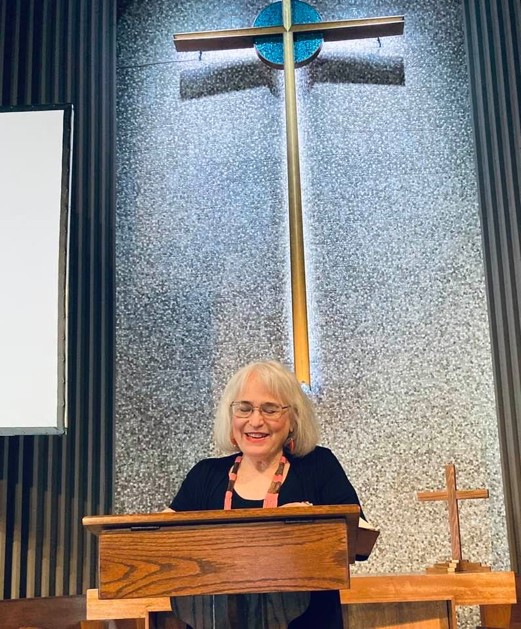
Dr. Jill Shook’s sermon on housing justice at Knox Presbyterian Church

22 Jun


Jill preaching at KnoxMy husband Anthony and I love to sing “Everyone “neath their vine and fig tree” to guests when they visit our home as we dine under our grape arbor, which is next to a fig tree. This motif is a repeated symbol in Scripture of a secure home. So, imagine this peaceful setting as I share with you today, but let’s also imagine how God shakes us out of our false security when we ignore God’s mandate to “do justice, love mercy and walk humbly with God” (Micah 6:8).

It is my prayer this morning that God would use me and these words as his vessel of love and justice.

After reading the seven chapters of Micah in one setting, I felt like I had just been on a roller coaster, with God’s severe judgment and severe mercy swinging back and forth throughout the book. Some find it hard to mix judgment with God’s love, but Micah has gifted us with a message in how to do this.

Micah was from Moresheth-Gath, a small town in southwest Judah, where Goliath was slain by David.  Micah’s father’s name is not given, which suggests that Micah was a descendent of the common people. Growing up in a small rural town, Micah likely took courage from the story of Goliath when he boldly called out God’s message of severe judgement on Judah and Jerusalem and 11 cities in chapter 2. It struck me that he was not calling out individuals by name, but cities. Micah championed the poor by condemning oppressors who gobbled up the land of peasants.   

Repeatedly God tells Israel that if she fails to keep God’s law, she will lose her land. They had unjustly taken land, now theirs was being taken. With severe mercy, God was now pushing people from their homes and their land. By calling out the cities in advance, they would know that God is just, going to any length to wake them up. And God is using humans, common people like Micah to announce this news.

Micah was the first prophet to predict the downfall of Jerusalem and told them to get ready to grieve the loss of their land. Most of the Hebrew prophets spoke to cities and nations, not to individuals. And so should we. Like Moses who spoke to Pharaoh, and Esther who spoke to the King, we speak to decision makers, to elected officials, to bring about justice and redemption.

Because our American culture is so individualistic, we often read the Bible in a personal way, as if it is only about personal sin, and we miss the sin of cities and nations—of cultures of violence supported by unjust structures, unjust allocations of land and funds, and un-just policies and priorities.

For example, Pasadena was beginning to experience a growing homeless crisis in the 90s but didn’t have a housing department to address this. We advocated for a housing department, and we got one. We now have Bill Huang as our Housing Director, who is deeply respected and committed to house our unhoused neighbors. Thanks to him, and a shift in thinking toward ending homelessness, as opposed to managing homelessness, and thanks to our advocacy efforts, the work of homeless service providers, and concerned churches and citizens, the homeless count in Pasadena declined by 56 % from 1,216 in 2011 to 527 in 2020.  To me, this is astounding considering how most other cities are seeing dramatic increases.

This process of cultural and structural change around well-researched best practices is what I call the redemption of the city.

But the cities that Micah called out were beyond redemption.

So, what was the sin and rebellion of the cities of Israel and Judah that Micah outlines as meriting such severe judgement?

It had to do with believing in false prophets more interested in money than in truth telling. It had to do with taking land and homes from the poor. Jerusalem was doomed because its beautification was financed by dishonest business practices, which impoverished the city’s citizens. 

In Micah Chapter 2: 2 is says:

When you want a piece of land,
    you find a way to seize it.
When you want someone’s house,
    you take it by fraud and violence.
You cheat a man of his property,
    stealing his family’s inheritance.

What does this remind you of?  Of homes of our brothers and sisters being bulldozed in Palestine? …“You take homes by fraud and violence” What about Bruce’s Beach taken from African Americans by eminent domain 100 year ago by the city of Manhattan Beach? … “You cheat a man out of his property and find a way to steal it.” It has been so hopeful for me to learn this may become the first time in the US that land taken may actually be returned to Blacks as a form of reparations.

What about closer to home where thousands of homes were taken from African Americans where the 210 Freeway and Parson’s engineering now sits? …“When you want a piece of land, you find a way to seize it.” What about when the city refuses to allow the proper zoning, so a church’s dream is possible of having affordable housing on its underutilized land?  This is the case on N. Fair Oaks.  

Micah also lists eviction as one of the other sins that God abhors:

Verse 2:9 says, you have evicted women from their pleasant homes
    and forever stripped their children of all that God would give them.

This verse reminds me of all the migrant children fleeing violence and seeking peace, who have been stripped of all God would give them. It also reminds me of those who are hanging on for dear life to their homes, having to choose between eating or paying rent. It’s very hard to imagine what it’s like for 66,000 people—almost half the size of Pasadena—who now make sidewalks and encampments their home in LA County …reminiscent of Calcutta. “People stripped of all that God has for them.”

In his powerful, award-winning book, Evicted: Poverty and Profit in America, Matthew Desmond has helped us to imagine how it’s possible that folks can spiral down into homelessness, and also to imagine the systemic factors at play. Desmond reminds us that once an eviction is on your record you have little chance of finding another place to live. He estimates 1 million evictions a year take place in the US. Matthew Desmond sums this injustice up by saying that “Black women are locked out, and Black men are locked up.” 

There are probably few if any members of Knox who have been evicted (or locked up), but if you go to some the African American Churches in town, too many are them are emptying out, in a sense evited from our city, because of skyrocketing housing costs, and being locked out of better paying jobs. 

Let me bring this closer to home, it is estimated that 1 in 5 students at PCC across the street are homeless, that is 19%! I spoke to a collage professor two weeks ago who said the there was at least one homeless student in every one of her classes. Could a vision be fostered whereby PCC’s large parking lots could have stacked parking with low-income apartments? This is not impossible.

Many in our city are “over-housed,” according to Pasadena Housing Director, Bill Huang. He says that many homeowners, especially older ones whose children have left for college, have more bedrooms than they need.

Here, I want to tell you a story of what happened when I was on staff at Lake Avenue Church, and director of the STARS after school tutoring program. Most of the low-income kids we served were living in overcrowded conditions. Several of our youth lived in a home with 10 families!!

I was driving some of these kids in my 8 passenger green Ford Taurus up toward Sierra Madre. Their eyes got bigger as the homes got bigger, and one said, “There must be a lot of families who live there!!” When I explained that it was probably just one couple, they said, “They must feel really lonely!” They may well be right.

Home sharing programs across the US are addressing both over-crowding, over-housed communities, and student homelessness and loneliness—reweaving society, changing cultures, and creating life-giving structures that reflect God’s justice and mercy. Perhaps such a program could take hold here if there is a vision for this.

For the past 7 years, my husband Anthony and I have housed a brilliant formerly homeless man in our back house. He has become like family. Each Wednesday we enjoy a meal, a time of prayer and Bible study. I wish you could all be part of these delightful discussions from a formerly homeless perspective. We have been humbled and transformed.

If you live in a single-family home, I want you to imagine what is in your back yard. Let’s consider how we might be better stewards what God has given us and how we might be blessed to house a student or an unhoused neighbor.

I believe Micah’s message to us is one of hope. Hope is fostered as we participate in action and see results. From Micah we see that God is real, that God does what he says. Micah foretells the destruction of Jerusalem, which was subsequently destroyed three times, the first one being the fulfillment of Micah’s prophecy. About 150 years later, the Babylonians destroyed Jerusalem in 586 BC.

Micah also tells us of an ideal that could be made real. God does not settle but give us an ideal to strive for with the mandate and means to do accomplish this ideal.  The heart of this message is in Micah chapter 4, the focus of my sermon today.

Listen to chapter 4: verses 2-4:  

“Come, let us go up to the mountain of the Lord,
    to the house of Jacob’s God.
There he will teach us his ways,
    and we will walk in his paths.”
The Lord will mediate between peoples
    and will settle disputes between strong nations far away.
They will hammer their swords into plowshares
    and their spears into pruning hooks.
Nation will no longer fight against nation,
    nor train for war anymore.
Everyone will live in peace and prosperity,
    enjoying their own grapevines and fig trees,
    for there will be nothing to fear.
The Lord of Heaven’s Armies
    has made this promise!

Here settling disputes without implements of war, is interlinked with peasant farmers freed from military oppression. Due to conflict and war, in 2020 alone, 82.4 million people in the world were displaced—all in just one year!! I thank God for the example of Knox to help house some of those displaced. I believe that God is telling us if we ended war, we’d keep people in their homes and we could live in peace, and secure, everyone under their own vine and fig tree.

Is ending war possible? Are there alternatives that work?  One of my favorite authors, Walter Wink in his book, Engaging the Powers, lists a sample of 73 significant conflicts resolved without a gunshot. I also love to point to Costa Rica, a county that chose to have no military, but instead invest in education and environmental initiatives. Compared to other Latin America countries, Costa Rica is thriving!

Is ending homelessness possible? A resounding yes! We know what ends homelessness, and its homes. Just one policy we helped get passed in 2001—and again we strengthened in 2019, requires that 20% of all new housing be set aside as affordable. This inclusionary policy has produced over 1,000 affordable units spread throughout the city, at no cost to the city.

In the past two years, our ASHA team has been able to build hope with multiple prayer vigils and implements of change to create multiple wins, gaining approval of 149 PSH—permanent supportive housing units, which ends chronic homeless.  They won the approval of another 112 affordable senior housing units with 10% for those experiencing homelessness right in the city center by the city hall.  

When one has their own vine and fig tree, a secure place to call home, with the support to thrive, not just survive, we end homeless for that one person.

Cynthia Kirby was homeless for 10 years in E. Pasadena and thanks to permanent supportive housing and the grace of God her life has turned around.  Today she is employed by the Baptist Church, reunited with her husband and daughter and is getting straight As in her college classes!

Dorothy Edwards was also homeless here in Pasadena for 17 years and is now in her secure apartment, and on the national board for the corporation of supportive housing speaking around the US.

Marv’s place, which looks like a Mediterranean villa and is not far from here, on the corner of Union and Mar Vista houses 19 formerly homeless families, none of whom worked and today all are thriving, going back to school or are fully employed. The stability of a home changed everything.

Even though most of our Bible translations may entitle Micah 4 as “God’s future reign”, I believe that this not about the future, but rather as Jesus said, the kingdom of God is at hand, present now, today. And that this passage is more about setting a standard of God’s ideal today. “Thy will be done on earth… in Pasadena, at Knox… as it is in heaven.”

Dr. Martin Luther King Jr. said, “I refuse to accept the view that mankind is so tragically bound to the starless midnight of racism and war that the bright daybreak of peace and brotherhood can never become a reality… I believe that unarmed truth and unconditional love will have the final word”.

To change our world and our cities, we need to change our thinking—to see housing as a right, not a commodity. I was delighted to see that a recent LA Times editorial promoted housing is right. The United Nations has recognized a right to housing for decades, but this document authored largely by Eleanor Roosevelt was never ratified by the US.  Micah is saying that it is God’s intention for everyone to have a right to housing, to live under their vine and fig tree, at peace and unafraid.  

Micah’s beautiful vision came out of a time when people were being ravaged by injustice and losing their homes and going into exile. Micah said that he ‘howled like a jackal and moaned like an owl” as he grieved over the destruction of these cities. Grieving is an important part of justice work.  

Do we let ourselves feel the pain of our unhoused neighbors and immigrants fleeing violence and fear? When we get to know our homeless neighbors by name and hear the stories of people forced into exile by war, we are forever changed.

In 7:8 Micah said, “Though I sit in darkness, I will rise again” and in 5:1 Micah challenged those called to destroy Jerusalem to “Mobilize!! Marshall your troops!”

With the love of Christ in our hearts we need to mobilize and marshal people of faith and conscience “to do justice, love mercy and walk humbly with our God” (Micah 6:8).

Our seemingly humble actions really do make a difference. When we go to the City Hall, I often see our elected officials’ heads bobbing as they count the number of people mobilized who are taking a stand. They need to borrow our courage and belief that God’s vision for cities is possible, today.  They need to know we have their back so they can be courageous and stand against the status quo.

It will take a holy army to change our policies. It has taken an army to get people like Cynthia Kirby and Dorothy Edwards housed. Not just the service providers, but changed policies, changed thinking, secured apartments, secured land, financing, architects, volunteers, and generous donors.  But each human being made in God’s image is worth it. These women are secure in their own apartments, where they pay only a third of their income on rent.

But most renters don’t have this security. Half of Pasadena pays more than 50% of their income on rents or mortgages and there is nothing that prevents a landlord from increasing rents as much as they can. Rent control is a great policy, but it has been given a very bad rap. We desperately need this in place.

It will take an army of committed people to institute this policy and debunk all the misconceptions about it. Anthony and I spent hours having a blast getting to know our neighbors and asking them to sign the official petitions a few years ago. It was a delight to see how many were eager to sign, even landlords. But we were just shy of the 13,000 signatures needed!

Micah has inspired my Quaker husband as well as many others to work to end war. And it has inspired us both to work so that everyone can have decent and secure homes that everyone can afford. This makes for a healthy mixed-income city, lowers traffic, brings investment and all kinds of local benefits. CA recognizes this as a best practice, requiring that every city plan for enough housing for all income levels. But the key word here is “plan.” …it doesn’t require implementation. No laws require that affordable housing be built, but today it is one of the biggest needs. All affordable housing is built due to advocacy.

Each year Anthony goes to Washington DC, to join hundreds of other Quakers who lobby elected officials to end war and poverty. Their vision is to seek a world free of war and the threat of war, a society with equity and justice for all. They haven’t reached that goal yet, but have had many victories along the way, such as this week’s passage in the House of the Repeal of the Authorization of the Use of Military Force in Iraq. This authorization has been used as a “blank check” by Presidents to justify military interventions.  Recently Anthony helped to orchestrate powerful coalitions of folks to meet with Feinstein and Padilla that helped to push this forward.

Our nonprofit, Making Housing and Community Happen, is seeking to end poverty by ending housing insecurity and homelessness. We are doing this with an amazing network of churches and volunteers and partners. Our seven teams do research, show up, speak with courage and truth and the love of Christ. We are creating the world we seek.  

We chose the vine and fig tree as a motif on the logo of our nonprofit as a reminder that God’s intention is for everyone to be housed in peace.  

We know this is possible. When Congress passed the Housing Act of 1968, it committed the nation to the goal of producing 2.6 million units of affordable housing a year. As a result, in the early 1970s we were close to meeting the need for affordable housing, but since then HUD and other programs for housing have been cut every year, even though the need has increased. At the time, half of the US budget is for our military, squeezing out domestic spending. Funding priorities are one of factors leading to today’s housing crisis.

It takes faith to imagine a world as it should be, especially with 66,000 people experiencing homelessness in LA County, but it was not always so. And other counties have figured out how to adequately house their population.

Examples give us hope. The vision of the vine and fig tree give us hope.Ending war and poverty is not an impossible dream because we know it is God’s intention.

Great things can happen in small cities and towns. Micah predicted that messiah would be born in Bethlehem, Micah 5:2 says, 

But you, O Bethlehem
    are only a small village among all the people of Judah.
Yet a ruler of Israel,
    whose origins are in the distant past,
    will come from you on my behalf.”

I John 15 Jesus is referred to himself as the vine, the true vine and we the branches. Let us cling to this vine as we lift God’s intentions for a world in which everyone is housed, and lives at peace and unafraid.   

Dr. Shook’s Sermon at Knox Presbyterian

Yes in God’s Back Yard

19 Jun

Lisa Williams

Lisa Williams is pastor of San Pedro United Methodist Church. She has helped lead a movement to shelter and house the un-housed in San Pedro and throughout Los Angeles County. She has worked with San Pedro United Methodist Church to create a vision and plan for an empty lot on the church’s property to become permanent, affordable housing.

Pastor Lisa Williams will explain how she addressed NIMBYism (“Not in My Back Yard”) by creating a vision and a plan to build supportive housing on an empty lot on her church’s property (YIGBY-“Yes in God’s Back Yard). She will explain how she became a catalyst for building stronger relationships and creating conversations in the community with elected officials, community leaders,  service providers and those who are fearful of their homeless
neighbors .

Tuesday, June 22 at 7pm

To register: https://us02web.zoom.us/meeting/register/tZ0pcOqupjgoHNJWy-jIOlrNuWyvIcOPebSO

After registering, you will receive a confirmation email containing information about joining the meeting.

PDF Flyer for YES IN GOD’S BACK YARD with Lisa Williams

MHCH Housing News for 2021

11 Jun

Here are our housing news for 2021:

Friday, June 4th Affordable Housing News. Our Executive Director is astonished when a city official immediately agrees to all her “asks” regarding Accessory Dwelling Unit. State Senator Portantino proposes a promising new bill to incentivize cities to encourage conversion of unneeded office space to affordable housing. And more….

ABCs of ADUs: Choosing a Contractor and Designer

25 May

ABC of ADU Contractor Designer

To Register, visit: 

https://us02web.zoom.us/meeting/register/tZIvdu6tqzgiHNDpxVvHh3X3sOAYfgVjHlPV

After registering, you will receive a confirmation email containing information about joining the meeting.


Click here for ABC of ADU:  PDF version

“Yes in God’s Back Yard”

25 May

Lisa WilliamsLisa Williams is pastor of San Pedro United Methodist Church. She has helped lead a movement to shelter and house the un-housed in San Pedro and throughout Los Angeles County. She has worked with San Pedro United Methodist Church to create a vision and plan for an empty lot on the church’s property to become permanent, affordable housing.

Pastor Lisa Williams will explain how she addressed NIMBYism (“Not in My Back Yard”) by creating a vision and a plan to build supportive housing on an empty lot on her church’s property (YIGBY-“Yes in God’s Back Yard). She will explain how she became a catalyst for building stronger relationships and creating conversations in the community with elected officials, community leaders,  service providers and those who are fearful of their homeless
neighbors .

Tuesday, June 22 at 7pm

To register: https://us02web.zoom.us/meeting/register/tZ0pcOqupjgoHNJWy-jIOlrNuWyvIcOPebSO

After registering, you will receive a confirmation email containing information about joining the meeting.

PDF Flyer for YES IN GOD’S BACK YARD with Lisa Williams

Talking points to let our elected officials know that we want Pasadena to plan for 6,000 units of affordable housing in the next 8 years, as required by the state

24 May

Dear Supporter of Affordable Housing,

We have a golden opportunity to let our elected officials know that we want them to comply with a state mandate requiring it to plan for 6,000 units of desperately needed affordable housing in the next 8 years. Some in the City would like to continue our “slow growth” approach, which has produced only 388 units of low, very-low and moderate income housings in the past 8 years. This status quo approach will lead to more homelessness, more housing insecurity, and an increasing exodus of low-income people, many of whom are people of color and essential workers. Lack of affordable housing will also have a negative impact on our city’s schools, health, traffic, pollution, etc. 

Scroll down for talking points to use to contact elected officials and the Planning Committee, which is holding a meeting on the Housing Element on Wednesday, June 2, at 6:00 pm. Let them know we want them and the City Council to take seriously the RHNA requirement that the City plan for 6,000 units of affordable housing in the next 8 years. Please feel free to make policy recommendations based on the talking points provided below. Be sure to provide some personal background and reason for your concern. 

If you want to take part in the meeting, https://www.cityofpasadena.net/planning/planning-division/community-planning/general-plan/housing-element-update/#community-engagement

Submit public comment of any length to housingelement@cityofpasadena.net prior to the meeting day.

Mayor Victor Gordo vgordo@cityofpasadena.net
District 1 Tryon Hampton: Ms. Cushon Bell – cbell@cityofpasadena.net
District 2 Felecia Williams: Darla Dyson – ddyson@cityofpasadena.net
District 3 John Kennedy: Susana Porras – sporras@cityofpasadena.net
District 4 Gene Masuda: Noreen Sullivan – nsullivan@cityofpasadena.net
District 5 Jess Rivas: Margo Morales – mlmorales@cityofpasadena.net
District 6 Steve Madison: smadison@cityofpasadena.net
District 7 Andy Wilson: Pam Thyret – pthyret@cityofpasadena.net
For convenience, you can copy and paste all of the addresses from below:

TALKING POINTS

  1. I am deeply concerned about the lack of affordable housing in our city. According to the Planning Department’s Report of September 14, 2020, only 388 permits for moderate, low and very low income units were issued in the 2014-2021 RHNA period. The current RHNA requires that the City plan for over 6,000 units of affordable housing. That goal may seem high, but no one disputes that the need is real and urgent. I believe we are morally as well as legally obliged to do our best to meet this need. According to the last Housing Element, 43% of renters and 34% of homeowners are severely cost burdened, i.e. paymore than half of their income on housing. That adds up to around 20,000 residents of our city! We need the Housing Element to reflect this urgency and contain innovative ideas to ensure that the housing needs of Pasadena’s residents are met.
  2. I urge you to approve innovative proposals like allowing congregations to have affordable housing to be built on their underutilized land. RHNA is requiring 6,000 units of affordable housing to be built in the next 8 years and the HCD wants cities to come up with realistic plans to meet that goal. Churches have a track record of building affordable housing that is consistent with the character of neighborhoods. Phil Burns of the Arroyo Group has come up with a detailed plan to make sure that if churches build affordable housing, it will be in scale and consistent with neighborhood character. This comprehensive plan is superior to the one-size-fits-all approach that the state may impose if the cities don’t come up with plans tailored to their needs. I urge you to support the proposal to let congregations have the right to meet our city’s urgent need for affordable housing.
  3. I agree with Councilmember John Kennedy that the City needs to produce 1,000 units of affordable housing in the next 1000 days. We agree with Councilmember Kennedy that affordable housing needs to be built throughout the city. I urge the Planning Commission to recommend dropping all fees for ADUs to those renting to Section 8 tenants. We need to incentivize homeowners to build affordable ADUs.
  4. I am sure that you’re aware that our city and state are in an affordable housing crisis. Many are leaving our state because they can’t afford to live here. There has been no population growth in our city since 2015, in part because of our “slow-growth” housing policies. That’s why the state is mandating that the city plan for 9,000 units of housing in the next 8 years, with 6,000 units being affordable. Some say that our city is “built out” and there isn’t room for more housing, but that’s a myth. We have parking lots that could be utilized for housing. We have one-story commercial buildings that could include one or two stories of housing. We have underutilized office space and other buildings that could be converted to affordable housing. We have churches eager to have affordable housing built on their underutilized land. We need to make the zoning adjustments necessary to ensure “smart growth” in our city so that there is decent and affordable housing for everyone in our city.
  5. I urge the Planning Commission to take seriously the RHNA requirement that 6,000 units of affordable housing be planned for in the next 8 years. As you know, HCD will hold cities accountable for meeting their RHNA goal. If our City doesn’t show good faith in trying to meet these goals, it could open itself up to litigation and lose a lot of local control. If the City has not considered reasonable proposals for increasing the stock of affordable housing, like making zoning adjustments for congregational land, it could lose its certification or face lawsuits. The City would be wise to incorporate into its Housing Element, or better yet, pass ordinances, that would show good faith in meeting its RHNA goals for affordable housing.
  6. We desperately need affordable and supportive housing in our city. According to the most recent count, our city has over 500 homeless people, 350 of whom are sleeping on our streets and these numbers are likely to rise when the Eviction Moratorium is lifted. I urge you to make whatever zone changes are needed to ensure that the City can meet its RHNA goal of 6,000 units of affordable housing. We not only have a moral responsibility to house our unhoused neighbors, it makes our city safer and is good for business!
  7. I am concerned that if the City doesn’t plan for 6,000 units of affordable housing, people of color and low-income will continue to be forced to leave our city. So will police and other city workers. 55% of our teachers live 45 minutes to an hour away from our city. Many are forced to commute long distances to work in our city, thereby increasing traffic and pollution. Affordable housing will make our city more livable for everyone, and it’s good for our planet!
  8. I urge the Planning Commission to recommend that the City do its best to meet the RHNA goals of 6,000 units of affordable housing in the next 8 years because it will not only meet an urgent need for housing, it will also bring investment to our city. Most affordable housing is built with funds that come from state and federal sources. Our city has a 20-20-20 rule that requires that 20 % of hires, 20% of contractors and 20% of materials be local. Heritage Square North, which provides affordable housing for seniors, brought 6 million dollars in investment to our city! Our city also requires that those who work and live in our city, or have been recently displaced, be given preference. Affordable housing is an economic as well as social benefit to our city. We need the Housing Element to take these benefits into consideration as it plans for the future of our city’s housing needs.
  9. I am concerned that around 2,000 babies are born in our city each year, but we aren’t building enough housing to account fo population growth. Around 3,000 permits for housing were issued in the last 8 years, most of them at market rates. If this trend continues, many of our children will not be able to afford to live in Pasadena, or even in California. This is a statewide problem and many are leaving our city and our state because of a lack of affordable housing. Instead of stifling growth with onerous regulations and zoning, let’s plan our city so that our children can live here if they choose.
  10. I am concerned that many schools in our city have closed because many low-income residents have been forced to leave our city because of a lack of affordable housing. These low-income residents preform essential services in our city, as restaurant workers, house cleaners, gardeners, etc. Most city workers such as teachers and school staff are also unable to afford the rising cost of housing. We need to make sure that unneeded school property is used for affordable housing.
  11. I am concerned that overcrowding due to a lack of affordable housing is a health issue. The Latinx population was hardest hit by the pandemic in part because many work in low-pay “essential services” and then went home to overcrowded apartments where infectious disease spreads most easily. It is incumbent on the Planning Department and our City to reduce the overcrowding in our city by planning for much needed affordable housing, especially in areas where low-income people currently live and are been displaced due to gentrification.
  12. I am concerned that the Housing Element take into consideration renters, who comprise the largest segment of our city. There needs to be rent stabilization, robust renter protection, and ample rental assistance for those facing emergencies like temporary loss of job or unexpected medical expenses. Our elected officials often talk about “protecting” single family homeowners. It is equally important to protect renters. Incidentally, the prior Housing Element has many proposals for renter protection, most of which haven’t been implemented.
  13. I urge the Planning Committee to take seriously the new state mandate that the Housing Element take into consideration and plan for affirmatively furthering fair housing. Among other things, this means adjusting zoning so that affordable housing can be built throughout our city. The Housing Element also needs to address the problem of gentrification in Northwest Pasadena, which has led to the exodus of over a quarter of the City’s African American population. In light of Pasadena’s history of racial discrimination, it is important for the Housing Element to display real concern for racial equity and makes decent housing attainable for all.

MHCH Housing Justice Forum: Affirmatively Furthering Fair Housing

16 May

racial justice and housing affordable housing flyer May 16 evite finalJoin us for a discussion of how housing discrimination can be addressed through affirmatively furthering fair housing (AFFH). Under this federal mandate, strengthened by a state law passed in 2018, cities cannot simply wait for people to complain about being treated unfairly, they must proactively plan policies to ensure that everyone is given fair and equal treatment. Come learn how to make sure that our city’s Housing Element complies with AFFH.
Tues. May 25. 7:00-8:30 P.M.

Speakers: Phlunte Riddle and Anthony Dedousis of Abundant Housing

https://us02web.zoom.us/meeting/register/tZwsdumsqTIpE9fxdZsxQAVuVrokAax9_f7S

tZwsdumsqTIpE9fxdZsxQAVuVrokAax9_f7S

phlunte riddleDr. Phlunte Riddle will share her personal story about how discriminatory housing policies impacted her family. Former district director and external affairs consultant to Assemblymember Chris Holden, Dr. Riddle was appointed by Governor Newsom to the Juvenile Parole Board, also known as the Board of Juvenile Hearings. Dr. Riddle broke barriers and honed her leadership skills in the nearly 29 years she spent rising through the ranks of the Pasadena Police Department. She was the first African American female sergeant, lieutenant and adjutant to the chief of police in the history of Pasadena Police Department.

Anthony DedousisAnthony Dedousis is Director of Policy and Research at Abundant Housing LA, dedicated to making Los Angeles County a more affordable, diverse, and vibrant region where everyone can afford a place to live. His data-driven urban planning research and policy proposals encourage equitable housing growth.

Anthony has used data to help businesses recruit workers and solve problems, with experience in the banking, food and beverage, and tech industries. Originally from Long Island, New York, Anthony is a graduate of Harvard College and the University of Chicago’s MBA program. He lives in the Los Feliz neighborhood of Los Angeles.

For more info contact Jill Shook at jill@makinghousinghappen.com   

Website: makinghousinghappen.com                          Blog: makinghousinghappen.net

MHCH Membership

10 May
Thank you for your interest in Making Housing & Community Happen (MHCH)!We have a number of ways you can become involved to make a real difference in housing justice:

1. ALLY – Receive MHCH’s newsletter! We invite you to attend Monthly Housing Justice Forums (4th Tuesday Each Month) and we encourage your participation.
Visit our website makinghousinghappen.org and complete our newsletter form to keep in touch.

2. TEAM MEMBER – To join one of MHCH’s OPEN committees you will need to contact the committee leader for an interview. MHCH’s committees are as follows: ADU (OPEN), ASHA (OPEN), Safe Parking (OPEN), Congregational Land, North Fair Oaks Empowerment Initiative (OPEN), CLT (OPEN). Visit https://www.makinghousinghappen.org/subcommittees for more information.

3. LIAISON – Represent your congregation (MORE INFO: https://www.makinghousinghappen.org/church-liaison)
Note: To become a liaison you will need to set up an interview with Bert Newton, Liaison Network Coordinator. bert@makinghousinghapen.org

4. PARTNERSHIP – Some organizations are official partners with MHCH with our common goals aligned but each of us operating in our strengths and own mission. We are better and stronger together.

5. DONOR – To sustain our efforts we need one-time and ongoing monthly commitments. Just click on this link: Donations. You can also send a check made payable to our fiscal sponsor “Social Good” and sent to MHCH, 1628 N Garfield Ave, Pasadena CA 91104.

Check for donations

We feel so grateful for those that have so generously supported our efforts

6. There are other ways to become meaningfully involved that we are open to explore with you. Contact Jill Shook (jill@makinghousinghappen.org) to share ways that you might like to contribute.

To get involved, click on Membership Application. 

Continue reading

Our prayer vigil for affordable housing and racial justice was a great success

28 Apr

z vigil jillz vigil kennedy


Over 60 people took part in MHCH’s prayer vigil for affordable housing and racial justice at the New Hope Baptist Church on Saturday, April 24. Many religious and community leaders took part, including state senator Portantino,  Pasadena city council member John Kennedy (pictured on right) and many others (see below). They read scripture, prayed, and shared personal stories. Jill Shook (pictured on left) composed a powerful liturgy of confession of past and present racial injustices and a commitment to righting them. It was inspiring to see Black and white folks coming together to support congregations that want to have affordable housing built on their property, but cannot do so because of restrictive zoning laws. We are committed to help congregations have the right to build affordable housing not only here in Pasadena, but also in other cities around the state and the nation. Check out this video: https://youtu.be/7gZCXA4Mq_M 

This is not a one-and-done event. MHCH plans to have another prayer vigil in a month or so, as well as meet elected officials until they make the zoning adjustments needed to enable congregations to do their part to address the acute housing crisis. Our city has a state mandate to plan for 6,000 units of affordable housing in the next 8 years, and congregations want to help our city meet that goal. 

You can download a PDF version of  our program here  :Prayer Vigil program 

PRAYER VIGIL PROGRAM

z vigil bertOverview and welcome by Rev Bert Newton (pictured on right)

Welcome by Pastor Paul Jones

Opening prayers by Pastor John Stewart, Blair Miller, Ibrahim Naeem

z vigil dr waltonReflection/Story by Dr. Gilbert Walton (pictured on left)

Words of support by State Senator Anthony Portantino, Pasadena Councilmember John Kennedy

Reading of Scriptures.

  1. Hyepin Im (Faith and Community Empowerment): “If there are any poor in your towns when you arrive in the land….do not be hardhearted or tightfisted toward them. Instead, be generous and lend them whatever they need. Do not be mean spirited and refuse a loan because the year of release is close at hand.” Duet.15:7-9.
  2. Michelle Bailey (Friendship Church): “They will build houses and inhabit them; they will also plant vineyards and eat their fruit. They will not build and another inhabit, they will not plant and another eat.” Is.65: 21-22
  3. Rev. Marcos Canales (Pasadena Nazarene Church): “Then you want a certain piece of land, you find a way to seize. When you want someone’s house you take it by fraud and violence….you have evicted women from their homes and stripped their children of their God-given rights.” Micah 2:2,9.
  4. Rev. Sally Howard (All Saints Church): “Destruction is certain for you who buy up property so others have no place to live. Your homes are built on great estates so you can be alone in the land. But the Lord almighty has sealed your awful fate. With my own ears I heard him say, ‘Many beautiful homes will stand deserted’” Isaiah 5:7-9
  5. PJ Johnson: Yet they shamelessly cheat widows out of their property and then pretend to be pious by making long prayers in public. Because of this, they will be severely punished.” Luke 20:47
  6. Rev. DeRon Johnson (Calvary Christian Center): “Everyone will sit under their own vine and under their own fig tree, and no one will make them afraid.” Micah 4:4
  7. Rev. Brita Pinkston (Pasadena Foursquare Church): “The Spirit of the Lord is upon me, because he has anointed me to bring good news to the poor. He has sent me to proclaim release to the captives and recovery of sight to the blind, to let the oppressed go free, to proclaim the year of the Lord’s favor.” Luke 4:16-18
  8. Pam Wilson (Lincoln Avenue Christian Church): “And there was no poor among them, because people who owned land or houses sold them and brought the money to the apostles to give to others in need” Acts 4:34.

Prayer of confession and commitment

Rev Bert Newton: We confess that our city and other cities like ours have had a shameful history of racial injustice and discrimination that has harmed people of color in our city and all of Pasadena. We have treated people as if we are not all equally deserving of God’s bounty and a descent home. We repudiate all forms of discrimination and stand in solidarity in support of fair housing for all.

  1. Connie Tamkin (First United Methodist Church of Pasadena): “We confess the injustice of a massive land transfer from Mexicans to Whites from the 1848 Treaty of Guadalupe Hidalgo. California’s constitution had a Free-Soil provision, allowing whites to claim and own land while banning slaves, yet disallowing free Black people to claim land. This land which today is Pasadena was not exempt from this injustice.”

ALL TOGETHER: God, hear our confession of this injustice.  We commit ourselves to correct such historic wrongs.

  1. Liz Murphy (Throop Unitarian Universalist Church): “We confess the injustice of 1862 Homestead Act: US citizens were granted 160 acres free if farmed for five years. African Americans and Native Americans were not given citizenship status; therefore, were not allowed to participate.”

ALL: God, hear our confession of this injustice.  We commit ourselves to correct such historic wrongs.

  1. Pasadena City Councilmember John Kennedy: “Ezra Seymour Gosney founded the Human Betterment Association in Pasadena “to improve the human race,” resulting in over 6,000 sterilization operations in California, from 1909 to 1929, referenced by officials in Nazi Germany who adopted this practice. We denounce this horrific injustice and ask that this practice is ended in our prisons and detention centers today.”

ALL: God, hear our confession of this injustice.  We commit ourselves to correct such historic and present wrongs.

  1. Margaret Lee (Professor, Azusa Pacific University): “Mortgage Interest Deduction (MID) was created in 1913 to encourage homeownership. The US spends over ten times more on housing subsidies from these deductions for wealthy homeowners than on affordable housing allocation. This policy has allowed many in Pasadena to have deductions on first and second homes, while too many people of color have never been able to access homeownership.”

ALL: God, hear our confession of this injustice.  We commit ourselves to correct such historic and present wrongs.

  1. Patrice Marshall McKenzie (Immediate Past President, Pasadena Chapter of Alpha Kappa Alpha Sorority, Inc.):  “In the early 20th century, zoning laws were introduced to “protect” largely white, single family neighborhoods. Because multi-family zoning was allowed in certain neighborhoods and only single-family zoning in others, Pasadena became economically and racially divided.”

ALL: God, hear our confession of this injustice.  We commit ourselves to correct such historic and present wrongs.

  1. Lawrence Davy (Deacon, New Hope Baptist): “At one point 65% of Pasadena had racial covenants recorded on their home deed disallowing ‘non-Caucasians’ from purchasing their homes. This was to ‘protect’ their property, fearing ‘encroachment’ of African Americans, who were only allowed to live in NW Pasadena. The long and lingering shadows of segregation persist in Pasadena, especially in our school district.

ALL: God, hear our confession of this injustice.  We commit ourselves to correct such historic and present wrongs.

  1. Dr, Gilbert Walton (Deacon, New Hope Baptist Church): “By 1950, real estate sales were prohibited that would be ‘detrimental to property values’ if Black people were to move into a community.  Racial steering for home purchases is illegal today, but it continues. For example, in Pasadena, realtors say to potential homeowners that they need to have enough money to send their children to private schools.”

ALL: God, hear our confession of this injustice.  We commit ourselves to correct such historic and present wrongs.

  1. Andre White (Mitchelville Real Estate Group): “Without explicitly mentioning race, exclusionary zoning was still practiced long after racial covenants were made illegal in 1968. African-American neighborhoods were often zoned for uses such as ‘industrial” or “commercia’ and used as a buffer to segregate the community by race. This led to a high number of liquor stores and other less desirable businesses along Orange Grove. The less desirable businesses encouraged and supported illegal businesses. To correct this injustice, we must rezone these areas to allow for affordable housing and mixed-use development to improve these neighborhoods by removing less desirable uses.”

ALL: God, hear our confession of this injustice.  We commit ourselves to correct such historic and present wrongs.

  1. Anthony Manousos (Orange Grove Quaker Meeting). “Redlining prevented access to financial services and loans in predominantly African American neighborhoods. To obtain loans, enterprising African Americans created Family Thrift Saving and Loan which later became One United Bank on N. Lake and Washington Blvd which closed its branch in Pasadena but is nonetheless the largest Black-owned bank in the United States. Many banks such as Wells Fargo and One West targeted seniors and people of color for bad loans during the Great Recession, causing many to lose their homes and assets.”

ALL: God, hear our confession of this injustice.  We commit ourselves to correct such historic and present wrongs.

    1. Phlunté Riddle: “The 1949 Housing Act no longer required one-for-one replacement of housing units cleared. Money from this Act provided for ‘slum clearance’ and ‘urban renewal.’ But some called this ‘Negro removal’ because so many Black residents were displaced from their homes in name of ‘renewal.’ Approximately 100 homes were demolished to make room for Parsons Engineering. Often, not enough money was paid to families to afford another home in Pasadena.”

    ALL: God, hear our confession of this injustice.  We commit ourselves to correct such historic and present wrongs.

    1. Teresa Eilers (Union Station) “The 1959 Highway Act created a car-reliant society with highways that sliced through thriving Black communities across the US, leaving wealthier white neighborhoods intact. The 210 Freeway, which was built in the 1970s, combined with urban renewal, displaced thousands of mostly African American Pasadenans. This led to the decline of a Black Business District on N. Lincoln Ave that has never fully recovered. On the other hand, mostly white and wealthy residents of South Pasadena were able to block the 710 Freeway extension and preserve their neighborhood.”

ALL: God, hear our confession of this injustice.  We commit ourselves to correct such historic and present wrongs.

  1. Dr. Larry Campbell (Pastor, First AME).The 1968 Fair Housing act had unintended consequences. African Americans of means living in NW Pasadena could now move anywhere, but it began to unravel much of the mixed income fabric needed for a healthy community. Due to redlining and this unexpected outcome, property values plummeted, opening the doors for gentrification. Today many professionals own homes in NW Pasadena, pushing property values high and pushing out long time African American families.

ALL: God, hear our confession of this injustice.  We commit ourselves to correct such historic and present wrongs.

Moment of silence

Rev. Bert Newton: Please take a minute and silently reflect on other ways that as a society we have allowed racial injustice and ask God to help us to remove these barriers to an equitable and fair society.

Prayers of Petition

Rev. Bert Newton: We confess that we have not done enough to repair the damage caused by racial injustice in our city, and we renew our commitment for each of us to do our part. Now we will focus on prayers of petition for those without a home and for God to allow congregational land to be part of the solution. Let us pray:

  1. We pray for our brothers and sisters who are experiencing homelessness. At last count, in January of 2020, over 500 of our brothers and sisters were experiencing homelessness, almost 300 were completely unsheltered, living on our streets.

ALL: We pray for homes they can afford and for all that they need to thrive.

  1. 54% of those counted reported having lived in Pasadena an average of 21 years. Although African Americans make up 10% of our population, they accounted for 31% of people counted on that night.

ALL: We pray for homes they can afford and for all that they need to thrive.

  1. 24 households with children were experiencing homelessness on the night of the 2020 count, all of whom were staying in sheltered locations.

ALL: We pray for homes they can afford and for all that they need to thrive.

  1. 700 students in PUSD are also considered homeless by the McKinney-Vento Act, and a separate count found that approximately 19% of PCC students are experiencing homelessness.

    ALL: We pray for homes they can afford and for all that they need to thrive.

    1. There has been a 62% increase of homelessness among seniors in the past 3 years. The average age of death among people experiencing homelessness is 51 years compared to 73 years for the general population.

    ALL: We pray for homes they can afford and for all that they need to thrive.The majority (67%) of people counted on the night in 2020 count  identified as male, while 33% identified as female and less than 1% identified as transgender; 8% identified as LGBTQ.

    ALL: We pray for homes they can afford and for all that they need to thrive.

    1. 56% of youth and 14% overall reported having been in foster care.

    ALL: We pray for homes they can afford and for all that they need to thrive.

    1. 13% stated that they were currently fleeing domestic violence.

    ALL: We pray for homes they can afford and for all that they need to thrive.

    1. 38 persons identified as veterans.

    ALL: We pray for homes they can afford and for all that they need to thrive

    1. We pray that our city will allow churches to do what is right and fulfill their mission by providing the right zoning so that affordable housing can be built for those who are low income or experiencing homelessness.

    Moment of silence

    Rev. Bert Newton: Please take a minute and silently reflect on others in our city who suffer from the high cost of housing, the high cost of medical expenses, the loss of jobs pushing too many in our city into homelessness or who are on the edge on homelessness, causing them to live with constant anxiety. Ask God to help us to do what we can to prevent housing insecurity.

    PRAYER OF THANKSGIVIING: Rev. John Williams, Fellowship Monrovia

    (Please say “AMEN” after each expression of gratefulness.)


    • We are grateful that cities like Evanston and Manhattan Beach are making reparation for injustices committed against African Americans, restoring land and hope and opportunity. (AMEN.)
    • We affirm our city’s beautiful vision that “all Pasadena residents have an equal right to live in decent, safe and affordable housing in a suitable living environment for the long-term well-being and stability of themselves, their families, their neighborhoods, and their community.” (AMEN.)
    • We thank God for how affordable housing beautifies and strengthens our community by requiring local labor, local materials and local contracts thereby infusing millions of dollars into Pasadena’s economy. (AMEN.)
    • We are thankful that members of our City Council are committed to affordable housing and that they have the support of churches, homeless service providers and concerned citizens. (AMEN.)
    • We are thankful for the Housing Task force and ask for your wisdom and courage to exercise faith to be bold in their Imagination to bring about housing justice. (AMEN.)
    • We are thankful that churches want to be part of the solution to our housing crisis and are willing to use their land for affordable housing. (AMEN.)
    • We are thankful that Pasadena’s homeless count has decreased 56% over the past decade. (AMEN!)

    Moment of silence

    Rev. Bert Newton: Please take a minute and silently thank God for all the opportunities we have to make Pasadena a model for other cities. Thank God for all the nonprofits, faith congregations and those who give of themselves to bring about housing justice.

    Closing words and call to action  by Dr. Jill Shook

    Closing prayer by Rev. John McCall, Bethel Missionary Baptist Church

Fact Sheet on Overlay Zone: Making it possible for churches to have affordable housing built on their underutilized land

15 Apr

MHCH is pleased that the City is considering a zoning change (called an “overlay zone”) which  would allow churches to have affordable housing on their underutilized land. This could lead to over 1,000 units of affordable housing spread throughout the city. Seventeen churches in Pasadena have indicated interest in this and one church now has a proposal for 52 affordable units! To learn more about the overzone zone making this possible, download this fact sheet:

Overlay Zone Fact Sheet 2020.09.25

Talking points for Overlay Zone to allow congregations to build affordable housing on their underutilized land.

#1: We are asking the City Council to support an overlay zone because the time to address the need for affordable housing is now, more than ever. And we have religious organizations throughout the City eager to be partners in making this happen.

Simply put, an overlay will save significant time, significant money, and provide certainty for both the religious organizations willing to provide affordable housing and the communities where that housing will be located.

By supporting an overlay zone that will ensure the majority of housing that will be developed is affordable, the City can ensure that projects are feasible and done in a way that minimizes the need for City or other public money to make affordable housing happen.

An overly zone is needed and superior to other suggestions of incorporating such zoning to Specific Plan update of Public/ Semi-Public zoning designation so because these planning processes would not adequately address the unique needs of congregations.

#2: An overlay zone enabling churches to build affordable housing will provide new land that would not otherwise be available for affordable housing. This is a significant opportunity when so few sites exist. Using church land is a huge opportunity for affordable housing developers to have feasible and successful projects. When they work with churches, developers don’t have to buy land in advance or carry the insurance cost. They can be more confident of community support since they have the support of a church which is part of a neighborhood. Yet, if churches wish to supply affordable housing, the cost and time needed to create a zoning change on a case-by-case basis as opposed to an overlay zone, can be significantly lowered if there such a policy is in place. Plus, it makes the deal attractive to a more experienced developer.

#3:  An overlay zone enabling churches to build affordable housing will provide an opportunity for the city to significantly reach affordable housing production goals and further its goal of being a diverse community. Housing Element (2014-2021) vision:

 “All Pasadena residents have an equal right to live in decent, safe and affordable housing in a suitable living environment for the long-term well-being and stability of themselves, their families, their neighborhoods, and their community. The housing vision for Pasadena is to maintain a socially and economically diverse community of homeowners and renters who are afforded this right.” 

#4: An overlay zone that enables churches to build affordable housing provides an opportunity for churches to participate in addressing the homeless and housing crisis.  From the poll we conducted, 17 churches are interested in having affordable housing on their land, with the potential of 1,177 units if a Congregational Land Overlay Zone is passed. 95% of churches would support a Congregational Land Overlay Zone to help other churches build housing on their land. Additionally, 19 churches (nearly half of all respondents) would allow SAFE parking on their church’s parking lots. And 11 churches were open to having a FEMA trailer on their property. Twelve churches already own approximately 58 rental units. Only six of them rent at market rate.

#5: An overlay zone that would allow community minded congregations that are already willing and mission-driven to become partners with the city to meet a very real need make good sense.  This also allows religious institutions to practice their faith in a very tangible way. Community based organizations would do this sensitively and respectfully out of love for their neighbors. They will live with this for the long term, so design in keeping with the neighborhood and a commitment to good relationships with neighbors will go a long way in addressing NIMBYISM.

#6: An overlay zone enabling churches to build affordable housing will allows for both  flexibility and certainly enabling sensitive solutions and designs for each site. Certain development standards will need to be addressed to provide enough flexibility for projects to be feasible. An overlay zone allows for the kind of certainly with flexibility to balance sensitivity to the project and the adjacent neighborhood in regard to appropriate densities and parking requirements to enhance the character of the neighborhood.

#7: An overlay zone for churches to build affordable housing minimized the money, risk and time for affordable housing developers. They cannot invest a great amount of time, money and risk into rezoning processes, and they will not take this time when there are other, simpler opportunities available in other cities.

#8: Because churches are throughout the city an overlay zone would spread affordable housing development through the city providing geographic equity and opportunity and investment in neighborhoods. The city would be wise to take advantage of this since so few sites exist especially in all areas of the city.  In Pasadena, for example, we estimate that there is capacity to build approximately 5,000 units of affordable housing on excess congregational land (the number of affordable units needed with the new RHNA numbers for the 2021-2028 Housing Element cycle). We know that not all congregations will do this, but the potential is significant. An overlay zone would ensure that any housing be built would be within city guidelines appropriate for each community. We must recognizing the power of congregations as allies with their excess land, missional orientation, and base of support in the community.  An overlay zone would help the city to go a long way toward meeting an urgent need.

#9:: Church attendance is declining, Gallop says that 69% of U.S. adults were members of a church in 1998-2000, compared with 52% in 2016-2018. This is particularly the case within land-rich older and mainline churches. Some churches are looking to off-load over-sized parking lots, high-maintenance buildings, and extra space. With shrinking congregations, many churches are unable to keep up. Affordable housing on church land has enabled churches to bless their communities, stay within mission, and help to prevent displacement due to the cost of housing, the very thing that is hurting many Pasadena churches.  Should a church feel called to consider affordable housing on their property, an overlay zone enabling churches desiring to have affordable housing on their property would provide a huge leap forward in addressing the housing crisis.

#10: Churches have a successful track record of partnering with affordable housing developers to provide affordable dwellings on their excess land. Some churches have already put parking lots, buildings constructed for congregations much larger than those of today, and other space on their properties to higher and better use by including affordable housing. In partnership with National Core (which developed Marv’s place in Pasadena, the UMC church in Santa Ana will be providing 95 units, half for families and half for those experiencing homelessness. Churches are doing this because they are called to serve the community and particularly its most vulnerable residents. Yet at the same time, they are also often able to generate a modest level of economic benefit that stabilizes these often struggling, but longstanding and critical institutions of our social fabric. In some cases, affordable housing developers have even provided additional parking for a church or developed other community serving uses on a site. Adopting an overlay zone that would enable churches, feeling so lead, to provide affordable housing on their property. Such a policy would make the process more straightforward, facilitate high quality partnerships with affordable housing developers to create much-needed affordable housing.

#11: Rezoning church land is one way that the city can make right with past sins of racial inequities that served to displace people of color.  With Urban renewal, a thriving African American neighborhood where Parsons now sits was displaced, moving them away from the city center, which today is zoned for 90 units per acre. They were not given the opportunity to capture the added value of the land from up-zoning, but instead encouraged to leave. Thriving Black communities and businesses on N. Fair Oaks were also displaced because of urban renewal. The 210 Freeway pushed out even more people of color. Too many families were not sufficiently remunerated for their property to again buy in Pasadena.  And if they wanted to, banks often would not provide them loans and they often were barred from obtaining private mortgage insurance. Due to significant displacement, one church has 8 members left. Several have closed. As one pastor put it, their church building is in Pasadena, but no one from their congregation can afford to live here anymore. Rezoning church land to allow for affordable housing would serve to prevent more displacement and correct past sins.  Some Black churches are eager to provide affordable housing on their underutilized land, please allow them to do so.

#12: Churches are and have been for many years an indispensable part of our City’s social fabric and have dedicated themselves to feeding the homeless, tutoring children, raising the City’s youth, keeping people in their homes. This history of investment in the community and neighbors creates a perfect marriage with new neighbors living in affordable housing on their property.

#13:   Churches are and have been for many years an indispensable part of our City’s social fabric and but many today are on the ropes because of long term trends, COVID-19 and today some need ways to generate income and reduce expenses to be able to continue in their mission. Affordable housing on their property can do just that.

#14:  An Overlay Zone is a locally-focused solution that will do a better job than proposed state legislation. A local solution designed by the community enables us to craft the kind of creative neighborhood-based housing solutions that enhance the design, beauty and character of our city.