Tag Archives: housing

Affordable housing at Rose City Apartments in E. Pasadena

15 Apr
Rose Town Apartments, 170 N. Halstead St., Pasadena (Near the Sierra Madre Villa A Line Station)

There are 49 apartments that will be available for low-income residents this summer, and nine are set aside for those displaced from Pasadena in the last decade:

·        Studios start at $628 per month (income limit: $66,540)

·        One-bedroom units start at $780 per month (income limit: $74,880)

·        Two-bedroom units start at $936 per month (income limit: $89,880)

·        Three-bedroom units start at $1,081 per month (income limit: $103, 200)

Anyone who is interested should put their name on the interest list here: https://www.crpaffordable.com/rosetowninterest

Please contact RoseTown apartments at (559) 452-8250 or email us at RoseTown@BuckinghamPM.com.

Do not contact Jill Shook or info@makinghousinghappen.org. We do not have information about availability of these apartments.

Right to Return

In urban planning, the “right to return” refers to policies that prioritize displaced residents, particularly those from communities of color, for affordable housing in areas undergoing redevelopment or gentrification. These policies aim to redress historical injustices and ensure community stability.

MHCH is partnering with the Community Clergy Coalition to organize Right to Return initiatives for Pasadena and Altadena. Our current initiative concerns Pasadena’s Right to Return ordinance.

Seeking Displaced Individuals

Thanks in part to the advocacy of MHCH, Pasadena City Council passed an ordinance in August 2019 prioritizing displaced individuals for 20% of new affordable housing, which went into effect in September 2019. Since its implementation, it has only been utilized twice. Therefore, we are seeking individuals who have been displaced and wish to return. The Rose Town Apartments, expected to be completed in August, will have 9 units prioritized for displaced individuals. We are actively searching for qualifying individuals who can access these units.

Strengthening Pasadena’s Ordinance

Pasadena’s ordinance currently prioritizes units only for individuals displaced within the last ten years and limits the number of prioritized units to 50. Once fifty households have taken advantage of this ordinance, it will no longer be in force.

We will advocate for a more comprehensive ordinance. Displacement of low-income people of color has been occurring for decades, so we propose an ordinance that reflects this history. Additionally, we recognize that thousands of individuals have been displaced, thus we seek to remove the limitation on the number of prioritized units.

What About Altadena?

Furthermore, we will engage with the residents of Altadena to determine if there is a desire within that community to advocate for a similar ordinance.

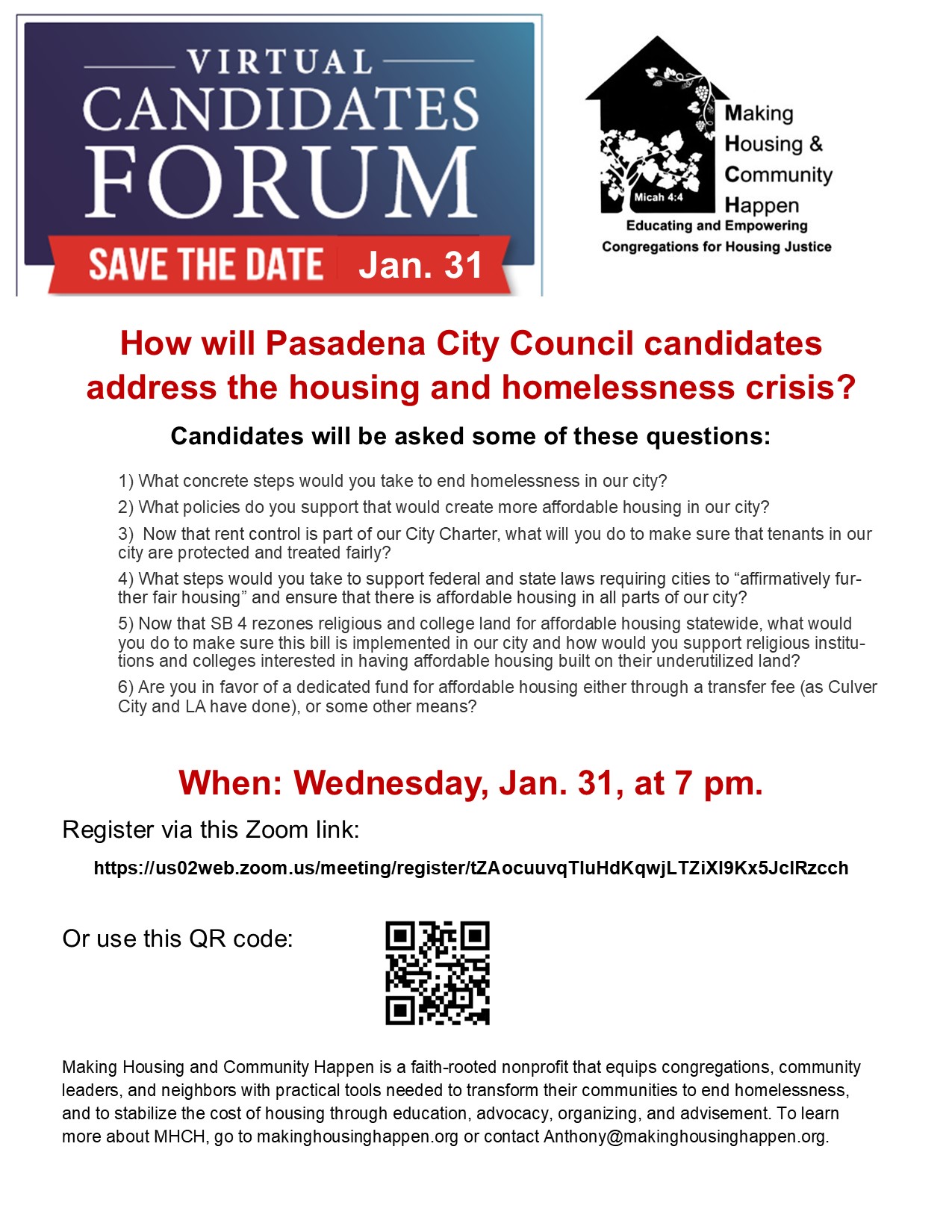
Pasadena City Council Candidates Forum Jan. 31 at 7 pm via Zoom

12 Jan

How will Pasadena City Council candidates address the housing and homelessness crisis?

You are invited to an MHCH Candidates Forum:

When: Wednesday, Jan. 31, at 7 pm.

Register via this Zoom link:

https://us02web.zoom.us/meeting/register/tZAocuuvqTIuHdKqwjLTZiXI9Kx5JclRzcch

Candidates will be asked some of these questions:

1) What concrete steps would you take to end homelessness in our city?

2) What policies do you support that would create more affordable housing in our city?

3)  Now that rent control is part of our City Charter, what will you do to make sure that tenants in our city are protected and treated fairly?

4) What steps would you take to support federal and state laws requiring cities to “affirmatively further fair housing” and ensure that there is affordable housing in all parts of our city?

5) Now that SB 4 rezones religious and college land for affordable housing statewide, what would you do to make sure this bill is implemented in our city and how would you support religious institutions and colleges interested in having affordable housing built on their underutilized land?

6) Are you in favor of a dedicated fund for affordable housing either through a transfer fee (as Culver City and LA have done), or some other means?

Download this PDF version of the flyer:

candidates forum flyer

Candidates Forum flyer 3

Housing, Health and Walkable Cities

5 Mar

Donald and I have recently began dialoguing about housing.  The conversation quickly moved to zoning changes needed to better plan our cities. Higher density housing often provides the opportunity for affordable units to be included… and it is often coupled with walkable streets.

If you ask people why they live where they do, most of the time it has to do with the cost of housing and safety. Where I live in Pasadena, the freeways are jammed from 3-7 pm with folks going home to what they see as safer, better, and often bigger and more affordable housing.

But they don’t always realize how this has a huge cost on the health of the environment, our bodies, our families and more.

Much research is being done on how to design our cities in a way that our jobs are closer to where we can afford to live, and with more walkable distances between where we live, shop, and work.

Jonathan, my other friend who is working on creating “complete streets” here in Pasadena, sent me this wonderful video from Every Body Walk. “Complete streets” allow space for bikes, walking, and cars — but cars slowed a bit to safer speeds.


I was inspired. I hope you are as well. Let me know what you think. Jill Shook

Making Housing Happen book review in Friends Journal

6 Feb

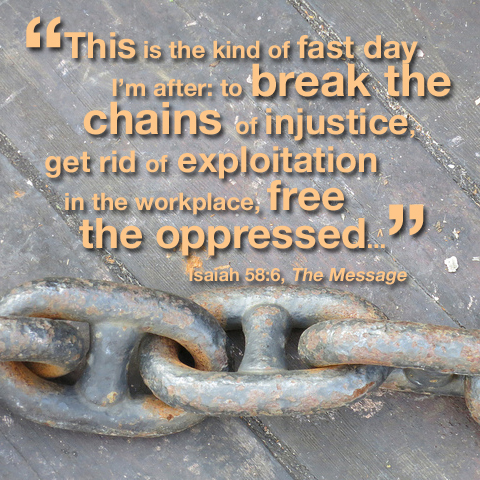
"This is the kind of fast day I'm after: to break the chains of injustice, get rid of exploitation in the workplace, free the oppressed..." --Isaiah 58:6I was excited to have Making Housing Happen reviewed in the January issue of Friends Journal. Published by Friends Publishing Corporation, the journal serves the Quaker and wider communities through “articles, poetry, letters, art, and news that convey the contemporary experience of Friends.”

The book reviewer is Diane Randall, former executive director of the Partnership for Strong Communities, a Connecticut-based nonprofit focusing on affordable and supportive housing. Diane, who is now executive secretary of the Friends Committee on National Legislation, writes:

How do people get caught up in the issue of affordable housing? Some do because they are poor and in need of a home that is safe and affordable, some because they see economic and environmental injustice played out in poor neighborhoods, and they are called to address it.

In the second edition of Making Housing Happen: Faith-Based Affordable Housing Models, editor Jill Suzanne Shook addresses reasons why people of faith engage in the long-term commitment to create affordable housing that builds stronger communities. This book will resonate with those of us who have sought to justify zoning laws for housing density that make homes more affordable, those who have lobbied for independent apartments for people who have been chronically homeless, or those who have used any other approach that allows people to have a place to call home. Builders who have volunteered sweat equity on projects for first-time homeowners will also be interested….

You can read the full review on the Friends Journal website.

Photo: cc by Matti Mattila

Keep Your Home California: Do you know someone who could qualify?

19 Jan

Take advantage of California’s $2 Billion Keep Your Home California Program for homeowners! I just heard about this AWESOME resource through Korean Churches for Community Development (KCCD) along with Hyepin Im also featured in my book Making Housing Happen. 

Keep Your Home California (KYHC) is the state’s $2 billion foreclosure prevention effort, established under the U.S. Treasury’s Hardest Hit Fund. There are four programs, with three aimed to prevent avoidable foreclosures by offering mortgage payment assistance to qualifying low- and moderate-income homeowners who are facing a financial hardship. Keep Your Home California’s four programs are the Unemployment Mortgage Assistance, the Mortgage Reinstatement Assistance, Principal Reduction and the Transition Assistance Program.

KCCD is a HUD-approved housing counseling agency for the KYHC Program. KCCD’s counselors will assist you in determining if you are eligible and provide counseling to begin applying for the KYHC Program.

Book Signing at Vroman’s 1/27

15 Jan

vromans_web