City Council granny flat flyer december 12-2017
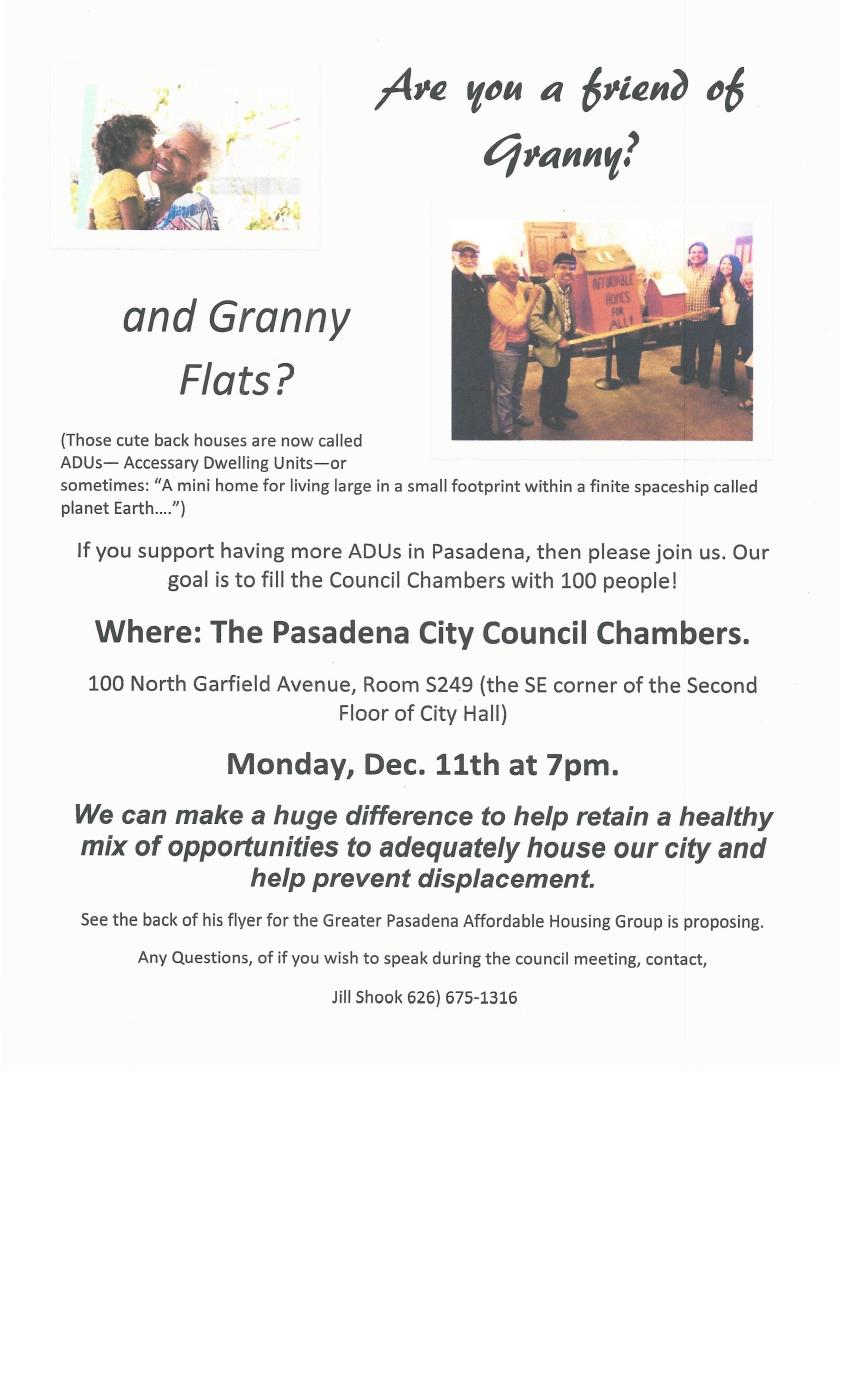
In Pasadena the city is making it nearly impossible to build a Granny Flat, those cute back houses that are now called ADUs–Accessory Dwelling Units. We’ve had a wonderful ADU committee meeting for the past year researching ways to make this kind of housing more accessible. David went to Pasadena’s Planning Office and asked what it would cost in fees to build an 900 s.f. ADU on his property. See it outlined below. We were shocked and saddened that our city is trying to make it nearly impossible for lower income homeowners, for example, seniors on fixed incomes, to create a tiny home for a caregiver or college student to live for a little extra income.
We are recommending that Pasadena follow the example of Temple City, where the fees for ADUs are $3,000.
If you are in the Pasadena area next Monday, join us at the City Council to help us lower these fees as well as eliminate a a required size. Stay tuned for more info about this!


 Lawrence K. Ho Los Angeles Times
I lived in an apartment until I was 8, when my parents scraped together a down payment and bought a modest little house on a cul-de-sac, taking hold of a deed that was our ticket to the kingdom of suburban California royalty.
Housing developments grew out of the dust all around us in eastern Contra Costa County, as working folks took out mortgages on their own sense of pride and belonging.
People extolled the benefits of owning, rather than giving money to the landlord. But in that time, you bought for the sake of inserting yourself into a dream decorated with shaded patios and manicured lawns, and not so much as an investment.
Today, home ownership in California is the best investment any of us will ever make, thanks, in large part, to a scarcity of housing. The pace of construction has not kept up with population growth and demand, so those of us with houses own a staggering amount of equity wealth that grows even as those without homes pay a higher price for survival.
California was always a model of stark contrasts in the realm of haves and have-nots. But as rents rise and wages stagnate, a majority of L.A.-area renters are paying more than onethird of their income on rent while thousands are paying 50% or more, with no end to these trends in sight.
Meanwhile, tens of thousands of homeowners in Los Angeles and Orange counties have enjoyed super-low interest rates and seen their equity rise to all-time highs. Roughly one decade after thousands of people lost their homes in the housing crash, 96.4% of Californians with mortgages owe less than their homes are worth…..
In Los Angeles and Orange counties, 533,000 homes are owned free and clear, and the value of them is $402 billion. That works out to about $700,000 in equity for each owner.
Those who hold current mortgages in the two counties have $842 billion in equity wealth, lifting the two-county equity total to $1.2 trillion.
“A lot of moola,” said Frank Nothaft, who compiled the numbers and is chief economist at CoreLogic, which does global real estate market research. Californians with active mortgages, Nothaft said, have more than one-quarter of the nation’s $8.2 trillion in equity.
Well, good for us, right? By clever planning or dumb luck — and it’s mostly the latter in my case — we are modern-day prospectors in another great California gold rush.
The gains are rightfully owned, and people who have worked and paid their bills and built up a nice cushion for their retirement have no reason to apologize.
But the state with the fifth-largest economy in the world has the highest poverty rate — about 20% — when housing prices are factored into the cost of living. So here’s a question: Unless we’re living in a real estate bubble that’s about to burst, which is certainly possible, do those who have prospered owe anything to those who have fallen further behind, including teachers, nurses, laborers and others essential to both our economy and our best definition of community?
To learn Lopez’ answer to this question, see

To: Pasadena City Council, 100 N. Garfield Ave.. Pasadena, CA 91109
Nov. 22, 2017
Dear Pasadena City Council Members,
Given that our state is in a housing crisis, with 1.3 million units short, thus pushing up the cost many times faster than wages, it is essential that you do all you can to help relieve this shortage. Therefore we recommend the following
In addition to helping to increase sorely needing housing stock, there are many good reasons to support all of our recommendations:
For all the above reasons, we ask that you support our position. Thank you for reading our letter and taking serious consideration of our recommendations.
Sincerely,
Jill Shook, Chair of the Greater Pasadena Affordable Housing Group
jill@makinghousinghappen.com
(626) 675-1316

Making Affordable Housing Happen event Sat. Nov. 18thOne day event on how and why to do biblically-based housing justice…
Who this is for? This is for property owners, landlord, pastors and church leaders, city officials, community developers. We want to work together to preserve and create new affordable housing options in Pasadena.
Where: Pasadena Church, 404 E. Washington Blvd., Pasadena, CA 91104
Date: Saturday, Nov. 18, 2017
Time: 8:30am registration—event from 9-4:30pm
Cost: Free, thanks to sponsors (which includes lunch)
Presenters/Facilitators:
Dr. Jill Shook, Dan Davidson, Pastor of Rose City Church and Chair of Pasadena’s Faith Partnership to End Homeless and Rosebud Coffee (social enterprise employing homeless youth), Bill Huang, City of Pasadena Housing Director, and Andre White, Affordable Housing Development Professional
RSVP: Register by Nov. 15th: https://www.eventbrite.com/e/making-housing-happen-in-pasadena-tickets-39132411095
Sponsors: Epicentre church, Lake Ave Church, Interdenominational Ministerial Alliance, Knox Presbyterian, Pasadena Church, Pasadena Community Christian Fellowship, Rose City Church, Rosebud Coffee, Summit Evangelical
Any questions, call or text 626-675-1316

Mexican NIMBY’s (not in my back yard) are preventing permanent supportive housing for our homeless neighbors. Jesus invited the most vulnerable to be the center of all his parables and teachings. We too need to be hospitable God will reward us. Isn’t it better to have our homeless neighbors housed rather than on the streets? We now have the funding with Measure H and Measure HHH. What we lack is the courage to overcome our fears and consider what really matters most- how we love our neighbors.
Homeless housing’s next big roadblock
“A vacant lot between two venerable Eastside landmarks — Evergreen Cemetery to the west and the El Mercado mall to the east — is the focus of a dispute that portends difficulties for the city’s plans to spur the construction of 1,000 units of housing each year for the chronically homeless. A nonprofit developer has an option to build 49 affordable-housing units on the property, with half of them dedicated to chronically homeless people who have been diagnosed as mentally ill. It’s exactly the kind of project the city intends to support with the $1.2-billion homeless housing bond that voters approved in November. But it’s been stuck for nearly a year in the committee headed by one of the most vocal supporters of that bond, Councilman Jose Huizar…..”
I thank God for Chase Andre our intern from Fuller Seminary who helped us identify 140 back houses in Pasadena. We plotted these on a map and identified two neighborhoods in our city that are very similar. With the only difference that one neighborhood had over 50 granny flats and the other had only 3. We compared the two neighborhoods in terms of traffic, parking, crime, visible character of the neighborhood, and property values. There was virtually no significant difference between these two neighborhoods. Our hope is that this will allay the fears of any higher density that may result from accessory dwelling units-those cute back houses that everyone would like to live in. I thank God for this article describing this comparative analysis that was published in our local star news on July 14th. Please pray with us that this article will serve to turn fear into many opportunities to adequately house our community .

“Fear of the unknown, fear of change and fear of lowered property values and traffic often stand in the way of constructive solutions to the Southern California housing crisis. One of the solutions, granny flats, known to planners as accessory dwelling units or ADUs, could add needed housing stock and help keep homes affordable for homeowners, with no cost to our cities themselves……”

After over a year of meetings with city staff and elected officials, our Greater Pasadena Affordable Housing Group successfully strengthened our local protection ordinance. Thanks especially to Darrell Cozen, who has played a calming, persistent, and passionate role in our group.
City alters ordinance regarding renters
“Pasadena’s City Council fixed a loophole in the city’s Tenant Protection Ordinance this week and expanded the number of renters who qualify, but the ordinance still does not offer protections to most of the tenants in the city.
Roughly one-half of Pasadena’s residents rent their homes, but only 91 tenants have benefitted from the Tenant Protection Ordinance in the last 13 years…..”


My friend Brad Fieldhouse is audacious. He challenged the Santa Ana city council with his God-sized belief that the city can do more. I was astounded when I visited this huge operation Brad helped set up in the bus terminal. Today Hope & Housing is transforming the lives of homeless.
Donna Gallup , the Executive Director of American Family Housing, the affordable housing developer that built permanent supportive housing for the formerly homeless from shipping container, will begin teaching in Azusa Pacific University’s social work department this month.
“For Kenneth Salazar, the past came back as a series of scenes in a fractured chronology.
Life after the Army had been one of dead-end jobs and episodes of sleeping in cars, each coming to an end when the vehicle was impounded.
“I woke up in a motor vehicle in other people’s driveway wondering, ‘What in the hell am I doing here?’ ” Salazar said.
Most recently, he was sleeping in a park when an outreach worker got him to go to the Courtyard, a shelter that opened last year in the former Santa Ana bus terminal. There he slept on a mat.
That turned out to be a steppingstone out of his past. For the first time since his discharge, Salazar, 60, now has a permanent home that cannot be impounded…..”
“Renters in the Los Angeles and Orange County metropolitan area would need an annual raise of $1,152 to keep up with expected rent increases in the next year, a study by real estate website Zillow says. The L.A./O.C. area came in second highest in the nation, after No. 1 Seattle at $1,248. That compares with $168 for the U.S. as a whole. In Seattle, L.A./O.C. and Boston, renters need their incomes to be at least $1,000 higher next year to have the same amount of money left over after paying the rent, according to the analysis…..” -Marilyn Kalfus


 Making Housing and Community Happen
